Abstract
Aim: With the increasing elderly population, the pain treatment needs of elderly patients increase. In this article, we aimed to present the clinical features of the patients presenting with pain due to non-cancerous causes over the age of 65 years. Material and Methods: The data of 642 patients older than 65 years who were admitted to Selçuk University Algology clinic between 01.01.2010 and 31.05.2018 were analyzed. Results: The median age of the patients was 72 (IQR: 67-78) years, and 62.8% (n=403) of the patients were female. The most common type of pain we observed in patients over 65 years of age who presented to algology clinic with pain was mechanical pain (54.9%). Interventional medication was applied in 39.9% of the patients. When the response to treatment was compared in terms of gender and age groups, no difference was found. Conclusion: By determining the clinical features in elderly patients who applied to the algology clinic, faster and effective pain relief can be provided.
Keywords: Elderly; pain; algology
Introduction
People with sixty-five years of age and up to age of 65
are accepted as the elderly population, and are
divided into three groups: between ages of 65-75 are
young elderly, between ages of 76-85 are elderly and
86 years of age and up to age of 86 are advanced
elderly
1. According to the state statistics, the elderly
population, which was 4.3% between 1994-2003,
increased to 8.7% in 2018. It is estimated that this
ratio will increase to 16.3% in 2040
2.
Among the elderly population, the most common
health problem causing hospital admission is pain.
Many conditions can be a cause of pain, which is
classified as cancer pain and non-cancerous pain, in
the elderly. Non-cancerous pain is also classified as
musculoskeletal pain, vascular origin pain,
neurogenic pain, and visceral pain
3.
It is known that 80% of the elderly population has at
least one chronic disease
4. The judgment that pain is
a condition accompanying aging is common. Also,
there are many factors such as hearing, vision, and
perception disorders that prevent pain assessment in
elderly patients. All these factors cause inadequate the
success for the success for the treatment of pain in the
elderly. The inadequate treatment causes functional,
emotional, cognitive and social problems
4. Medical
treatment is the first choice in the success for the
treatment of pain, no matter what type. In patients
who do not respond to medical treatment, pain
treatment is performed with interventional methods
5.
In this article, we aimed to present the pain profiles
of the patients who admitted to algology clinic with the
pain experienced for non-cancer reasons over the age
of 65, the treatment methods applied and the
responses to treatment.
Materials and Methods
Following the approval of the Ethics Committee,
7522 applications, between 01.01.2010 and
31.05.2018, were investigated in the Algology clinic of
Selçuk University Medical Faculty Hospital. One
thousand four hundred fifty of these applications
belonged to patients 65 years and older. Patients
admitted with cancer pain were excluded from the
study. Also, recurrent applications were evaluated as
a single patient. The files of 642 patients who met all
the criteria were evaluated retrospectively. Age,
gender, pain type, pain medication type, and
interventional medication were evaluated. The pain
type was classified as neuropathic, mechanical,
ischemic, myofascial and headache. Interventional
techniques were classified as trigger point injection,
epidural steroid injection, radiofrequency lesions,
catheterization, and epidural steroid injection with
radiofrequency lesions. Decrease in pain values by
more than 50% over three months according to the
first evaluation was accepted as the success for the
success for the treatment of pain.
The data were divided into three groups according to
age groups: Group I (aged 65-75), Group II (aged 76-
85) and Group III (86 years and older).
Statistical analysis
Data were statistically analyzed using SPSS Version
22.0 (Statistical Package for the Social Sciences Inc.,
Chicago, IL, USA). Data were tested for normality
with Kolmogorov–Smirnov test. Descriptive statistics
were performed in all the patient groups; numerical
data were expressed as median (inter-quartile range)
while categorical data were given as percentages.
Patient features were compared using Chi-Square or
Fisher’s Exact Test for categorical variables and the
Kruskal-Wallis Test for numerical variables. p<0.05
value was accepted as statistically significant.
Results
During the study period, 7522 patients were admitted
to the Algology clinic, and 642 of them were analyzed.
The general characteristics of the patients included in
the study are presented in Table 1.
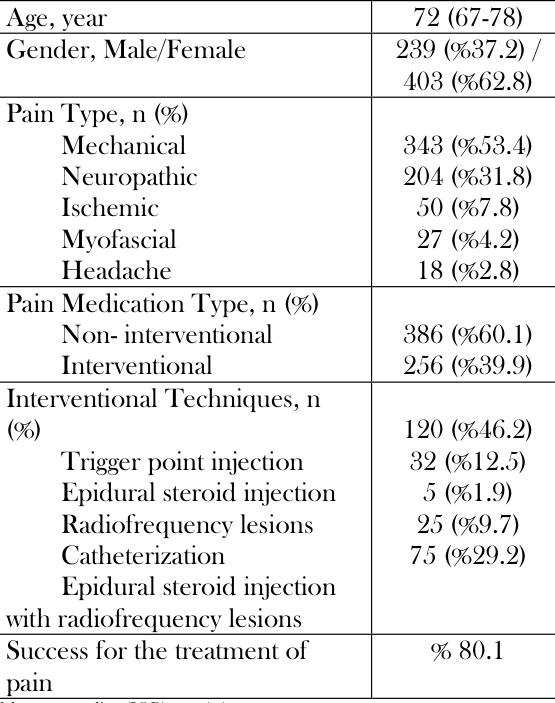
Values are median (IQR) or n (%).
The median age of the patients was 72 (IQR: 67-78)
years, and 62.8% (n=403) of the patients were female.
The proportions of pain types were as follows:
Mechanical, 53.4% (343); Neuropathic, 31.8% (204);
Ischemic, 7.8% (50); Myofascial, 4.2% (27);
Headache, 2.8% (18). While 60.1% of the patients
had non-interventional medication, 39.9% had
interventional medication. Of the patients treated
with interventional medication, 46.2% were
administered trigger point injection, 12.5% epidural
steroid injection, 1.9% radiofrequency lesions, 9.7%
catheterization and 29.2% epidural steroid injection
with radiofrequency lesions. Success for the treatment
of pain was provided in 80.1% of all patients.
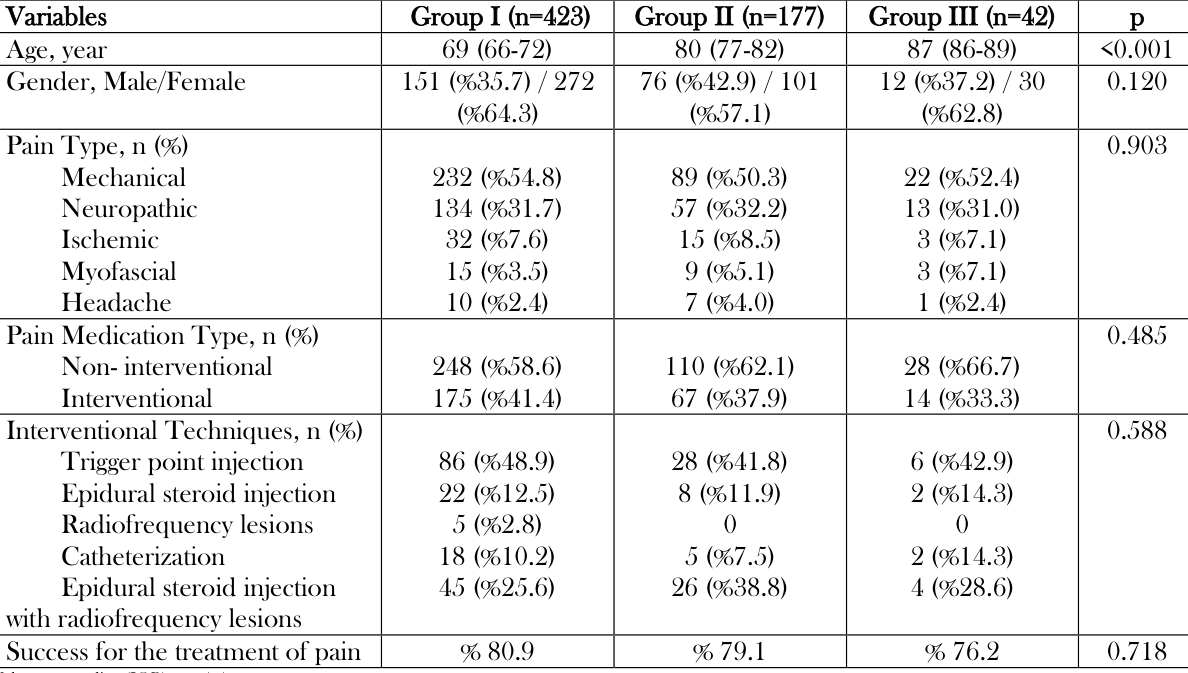
Comparison of the clinical features of patients
according to age groups is shown in Table 2. There
was no significant difference between the age groups
in terms of gender, pain type, pain medication type,
interventional techniques and success for the
treatment of pain (Respectively, p=0.120, p=0.903,
p=0.485, p=0.588, and p=0.718). The most common
type of pain in all age groups was mechanical pain
(%58.4, %50.3 and %52.4, respectively), while the
most common interventional techniques were trigger
point injection (%48.9, %41.8 and %42.9,
respectively).
Comparison of the clinical features of patients
according to gender are shown in Table 3. There was
no significant difference between the gender groups
in terms of age, pain type, pain medication type,
interventional techniques and success for the
treatment of pain (Respectively, p=0.158, p=0.288,
p=0.653, p=0.150, and p=0.342). The most common
pain type in both genders was mechanical pain, while
the most common interventional techniques were
trigger point injection.
When the response to treatment was compared in
terms of gender and age groups, no difference was
found.
Values are median (IQR) or n (%).

Values are median (IQR) or n (%).
Discussion
Various epidemiological studies showed an increase
in the incidence of pain with the increase in age
6,7. In
particular, the incidence of pain is higher in patients
aged 65-76 years (defined as younger age group). The
frequency of chronic pain in women is higher than in
men
7. As a result of our study, we found that the rate
of women is higher in patients presenting with pain
complaints similar to the literature.
The prevalence of chronic pain in elderly patients was
reported as 58-70%. Musculoskeletal disorders (e.g.,
osteoarthritis, low back pain) and neuropathic pain
are the most common causes of pain in the elderly
8,9.
The most common type of pain we observed in
patients over 65 years of age who presented to
algology clinic with pain was mechanical pain
(54.9%). This definition includes radicular pain, facet
joint and sacroiliac joint degeneration pain and other
atralgic pains. In the present study, the second most
common pain type is neuropathic pain. This group
includes diabetic neuropathy, postherpetic neuralgia,
post-thoracotomy pain, trigeminal neuralgia, and
various neuralgias. Pain caused by circulatory
disorders in the extremities or obstruction in
peripheral vessels was included in the ischemic pain
group. The rate of patients with ischemic pain was
4.2% in the present study. Myofascial pain syndrome
is a condition that manifests itself in sensitive regions
called the trigger point in one or more muscles and/or
connective tissue. Pain, movement limitation,
weakness and rarely autonomic dysfunctions may
occur due to these sensitive points. As a result of our
study, the rate of patients with myofascial pain
syndrome was found to be 7.8%. The percentage of
patients presenting with headache was 2.8%. As a
result of various studies, the incidence of headache in
the elderly was found to be between 3.9% and
4.4% 10,11. The low rate in our study can be attributed to
the fact that these patients are mostly referred to
neurology clinics.
The most common pain management in the elderly
is the use of oral or injectable analgesic drugs
11. Many
points should be considered in elderly patients during
analgesic medication use. A large number of drugs
that use chronic diseases present in elderly patients
may interfere with analgesics. As an analgesic, the
drug with the least side effect profile should be
selected. And it should be noted that the metabolism,
absorption, elimination and dispersion volumes of
drugs change with aging
10.
The first-choice drugs for pain, especially for mild to
moderate pain, are nonsteroidal anti-inflammatory
drugs (NSAIDs) and paracetamol. The
gastrointestinal, renal and cardiac side effects of these
drugs increase with aging.
In the treatment of severe pain in elderly patients, the
combination of nonopioid and opioids is
recommended
12. It is known that the
pharmacodynamic sensitivity of opioid analgesics is
increased in elderly patients
13. There is an increase in
the side effects of opioids with aging. And also, there
is a decrease in renal clearances of opioids with aging.
A higher maximal plasma concentration is observed
in opioid use compared to young people.
Considering the problems of analgesic drugs in
elderly people, it is reported that early invasive
treatment in elderly patients will be beneficial in many
studies
14,15. There is no definitive algorithm for
invasive pain management in elderly patients. In our
clinic, we prefer to apply early invasive pain treatment
to patients in whom medical treatment is insufficient.
Trigger point injection is the most common invasive
treatments (46,2%) and the second most common
invasive treatment is radiofrequency lesions (31.1%).
Radiofrequency lesion is an effective and easily
applied method based on the principle of creating
peripheral or central nerve tissue damage. With the
help of a special generator and special electrodes,
heat is supplied to the desired nerve and damage is
caused.
Firstly, the diagnostic block is applied to the patients
to be treated so that it is tried to have an idea about
the effectiveness of the treatment
15. We applied a
diagnostic nerve block to all patients who had planned
radiofrequency lesions in our clinic. Patients who had
more than a 50% reduction in pain after the block
were included in the radiofrequency lesions
application. We applied radiofrequency lesions in
patients with cervical and lumbar facet joint pain,
sacroiliac joint pain, trigeminal neuralgia and
sympathetic pain in the lower extremity.
It is recommended that epidural steroid should be
applied to patients presenting with waist or neck pain
as a component of radiculopathy, secondary to
lumbar or cervical disc pathology or spinal stenosis
16.
Epidural steroid applications can be performed by
interlaminar, transforaminal and caudal techniques.
In our clinic, epidural steroid application is preferred
with transforaminal technique. In patients with
radicular pain, transforaminal steroids were applied,
and radiofrequency lesions were applied to patients
with pain due to facet joint or sacroiliac joint
degeneration.
In the treatment of myofascial pain, dry needle
applications or saline, steroid or local anesthetic
injections are performed on the trigger points
15. We
use local anesthetics lidocaine for trigger point
injection.
As a result of our study, 80.1% of the treated patients
had a decrease in pain values by more than 50% over
three months according to the first evaluation.
Conclusion
The most common pain type in elderly patients who
applied to the algology clinic is mechanical pain.
Medical treatment is the most common treatment
modality. However, invasive therapies were applied
when medical treatment could not be applied or
inadequate. With the help of invasive treatments, the
pain of the patients was decreased. Due to the
accompanying diseases in elderly patients, the
methods used do not always yield good results and
may be insufficient. However, early application of
these methods is noteworthy for reducing the need
for analgesics and avoiding side effects.
Funding
None.
Conflict of Interest
None.
References
- Andersson HI, Ejlertsson G, Leden I, et al. Chronic pain in a geographically defined general population: Studies of differences in age, gender, social class, and pain localizaiton.Clin J Pain. 1993;9:174-82.
- Türkiye İstatistik Kurumu, İstatistiklerle Yaşlılar. Erişimtarihi:20.04.2019 Available from: www.tuik.gov.tr/PdfGetir.do?id=27595.
- Jones MR, Ehrhardt KP, Ripoll JG, et al. Pain in the Elderly. Curr Pain Headache Rep. 2016;20(4):23.
- Hanks-Bell M, Halvey K, Paice JA. Pain assessment and management in aging. Online Journal of Issues in Nursing. 2004;9: 3
- Gökçe Kutsal Y. Ağrı In: Gökçe- Kutsal Y(ed). Temel Geriatri, Ankara, Güneş Kitabevii2007:279-8.
- Brattgerg G, Parker MG, Thorlund M. A longitudinal study of pain:reported pain from middle age to old age. Clin J Pain. 1997;13:144-9.
- Gallegher RM, Verma S, Mossey J. Chronic pain, Sources of late-life pain and risk factors for disability. Geriatrics. 2000;55:40-4,47.
- Ersek M, Turner JA, Cain KC, et al. Chronic pain self-management for older adults: a randomized controlled trial. Pain. 2008;138:29-40.
- Fine PG. Chronic pain management in older adults: special considerations. J Pain Symptom Manage. 2009;38:4-14.
- Wang SJ, Fuh JL, Lu SR, et al. Chronic daily headache in Chinese elderly:prevalence, risk factors, and biannual follow up. Neurology. 2000;54:314-9.
- Prencipe M, Casini AR, Ferretti C, et al. Prevalence of headache in an elderly population: attack frequency, disability, and use of medication. J Neurol Neurosurg Psychiatry. 2001;70:377-81.
- Gloth MF 3rd. Pharmacological management of persistent pain in older persons: Focus on opioids and nonopioids. J Pain. 2011;12:14-20.
- Nikolaus T, Zeyfang A. Pharmalogical treatments for persistent non-malignant pain in older persons. Drug Aging. 2004;21:19-41.
- Prager JP. Invasive modalities for the diagnosis and success for the treatment of pain in the elderly. Clinics of Geriatric Medicine. 1996;12:549-61.
- Özyalçın NS. Yaşlı hastalarda ağrı kontrolünde invaziv girişimler. Ağrı. 2004;16:26-36.
- Raj PP. Epidural steroid injections. In: Raj PP, ed. Practical Management of Pain. rded. StLouis:MosbyInc.2000;732-43.
Copyright & License
This article retains the copyright and licence terms stated at its original publication. The journal's later licensing policy does not replace or amend those terms.
Read the original article PDF for the applicable copyright and reuse terms.