Abstract
Giriş: Literatürde çok sınırlı sayıda olan; gebelerde komplike hemoroidlerde cerrahi tedavinin güvenli olup olmadığını belirlemek amacı ile kliniğimizde gebelik sürecinde cerrahi tedavi uygulanan hastaların tedavi sonuçlarını sunmayı amaçladık. Gereç ve Yöntemler: Ocak 2011 ve Nisan 2018 yılları arasında hemoroid cerrahisi uygulanan hastaların dosyaları geriye dönük olarak incelendi. Konservatif ve/veya medikal tedaviden fayda görmeyen hastaların yaş, gebelik ayı, daha önceden hemoroidal hastalık ve anorektal cerrahi öyküsü, başvuru şikayeti, ek hastalıkların varlığı, vücut kitle indeksi, daha önce medikal tedavi alıp almadığı, fizik inceleme bulguları, kolonoskopi/rektoskopi sonuçları, eşlik eden diğer anorektal bölge hastalıkları, yapılan ameliyat tekniği, komplikasyon varlığı, hastanede kalış süresi, kontrol muayenesi ve tedavi sonuçları kayıt altına alındı. Sonuç: Hemoroid cerrahisi uygulanan kadın hastaların 13 (%17.8)' ü gebe idi. Hastaların 8 (%61.5)' i 3. trimesterde, 4 (%30.7)' ü 2. trimesterde ve 1 (%7.6)' i 1. trimesterde idi. En sık başvuru şikayeti ağrı ve kanama idi. Ortalama yaş 30 (20-40) yıl ve vücut kitle indeksleri 27 (23-36) kg/ m2 idi. Hastaların 9 (%69.2)' na hemoroidektomi (milligan morgan veya ferguson tekniği ile), 2 (%15.3)' ne hemoroidektomi ve sfinkterotomi, 1 (%7.6) 'e hemoroidopeksi ve 1 (%7.6)' ne trombektomi uygulandı. Ortalama ameliyat süresi 30 (10-35) dk ve hastanede kalış süresi 2 (1-3) gün idi. Erken dönemde 11 (%84.6) hastada ağrı ve 1 (%7.6) ileus tablosu görüldü. Hastalarımızda erken ve geç dönemde başka komplikasyon olmadı. Tartışma: Gebelik sürecinde oldukça sık görülen hemoroidal hastalığın öncelikli tedavisi medikal ve konservatif yöntemler olmalıdır. Ancak akut hemoroidal hastalığın varlığında; yeterli cerrahi, anestezi ve teknik olanaklara sahip merkezlerde hemoroidal cerrahi düşük komplikasyon oranları ile uygulanabilmektedir.
Keywords: Hemoroid; Gebelik; Hemoroidektomi
Abstract (English)
Aim: We reviewed the treatment outcomes of pregnant women who received surgical treatment at our center with the intention of assessing safety of surgical intervention for complicated hemorrhoids during pregnancy; a subject on which there is limited literature.
Material and Methods: Records of the patients who received surgical treatment for hemorrhoids between January 2011 and April 2018 were retrospectively analyzed. The information of the patients who did not respond to medical and/or conservative management was recorded by taking the following parameters into account: age of the patient, month of pregnancy, history of hemorrhoids or anorectal surgery, presenting complaints, comorbidities, body mass index, previous medical treatment, physical examination, colonoscopy/rectoscopy results, co-existing anorectal disorders, the surgical procedures performed, complications, duration of the hospital stay, follow-up examination and the outcome of the surgical procedure performed.
Results: Thirteen (17.8%) of the female patients who received surgical treatment were pregnant. Eight (61.5%) of the pregnant patients were in the third trimester, 4 (30.7%) were in the second trimester, while only 1 (7.6%) was in the first trimester. The most common presenting complaints were pain and per rectal bleeding. Mean age of the patients was 30 (20-40) years, whereas mean body mass index was 27 (23-36) kg/m2. Hemorrhoidectomy (Milligan-Morgan or Ferguson) was performed on 9 (69.2%), hemorrhoidectomy and sphincterotomy on 2 (15.3%) patients, hemorrhoidopexy on 1 (7.6%) patient while excision of thrombus was performed on 1 (7.6%) patient. Average length of the surgical procedure was 30 (10-35) minutes whereas the duration of the hospital stay was on average 2 (1-3) days. During the early postoperative period 11 (84.6%) patients complained of excessive pain while ileus was observed in 1 (7.6%) patient.
Conclusion: Hemorrhoidal disease is quite common during pregnancy and medical/conservative treatment should be the first-line remedy. But for the patients presenting with acute hemorrhoidal disease, surgical intervention can be applied with minimal risk of complications atcenters with adequate surgical, anesthetic and technical capabilities.
Introduction:
Hemorrhoids are part of normal anatomy of distal
rectum and anal canal
1. Hemorrhoidal connective
tissue consists of smooth muscles and vascular tissue
covered by mucosa. It plays a role in defecation and
ensuring continence. Even though its exact etiology is
not clear hemorrhoidal disease is a multifactorial
disease that can be attributed to factors such as eating
habits, toilet habits, constipation/diarrhoea, genetic
factors, age, gender, long standing hours, strenuous
exercise and existence of various medical problems
1.
Hemorrhoidal disease is very common in the society
and mostly treated with lifestyle audit, changes in
nutritional habits, sitz baths and medical treatment
(topical or systemic) methods. Surgical treatment can
be used in cases where the symptoms do not resolve
with these conservative methods, and inconditions
such as large prolapsed hemorrhoid packets,
recurrent thrombosis, presence of external
components, ulceration, presence of gangrene, and
co-existing fissure and fistula that require surgical
intervention
2.
Treatment of hemorrhoidal disease varies with
severity of the disease, personal risks and medical
conditions. Conditions such as inflammatory bowel
diseases, chronic liver disease, pregnancy,
immunosupression, lymphoma/leukemia etc. may
complicate the treatment process. One needs to be
careful when faced with these conditions that limit
medical treatment and also make surgical
intervention risky. Pregnancy is one of these special
conditions.
There is increased risk of hemorrhoidal disease
3 and
acute crisis (prolapsus, thrombosis and intractable
pain) during the second and third trimesters. For
normal population surgical treatment is a viable
option in case of acute crisis. But during pregnancy,
most surgeons postpone the surgery as much as
possible due to the complications of the surgery and
anesthesia which can affect the mother and the fetus.
It is mostly difficult to draw the thin line between the
complicated symptoms of hemorrhoidal disease and
the possible complications of the surgery.
In our study we intend to present the treatment
outcomes of pregnant women who received surgical
treatment at our center with the intention of assessing
safety of surgical intervention (hemorrhoidectomy,
hemorrhoidopexy, thrombectomy) for complicated
hemorrhoidal disease during pregnancy; a subject on
which there is limited literature.
Material and Methods:
Medical records of the patients who received surgical
treatment (hemorrhoidectomy, hemorrhoidopexy,
thrombectomy) for hemorrhoids between January
2011 and April 2018 were retrospectively analyzed.
The study was approved by Baskent University
Institutional Review Board (Project no: KA 18/101)
and supported by Baskent University Research Fund.
Files of a total of 251 patients were analyzed. Of these
patients 142 (66.1%) were male while 73 (33.9%) were
female. Thirteen (17.8%) of the female patients were
pregnant. The information of the patients who did not
respond to medical and/or conservative management
was recorded by taking the following parameters into
account: age of the patient, month of pregnancy,
history of hemorrhoids or anorectal surgery,
presenting complaints, comorbidities, body mass
index, previous medical treatment, physical
examination, colonoscopy/rectoscopy results, co-
existing anorectal disorders, the surgical procedures
performed, complications, duration of the hospital
stay, follow-up examination and the outcome of the
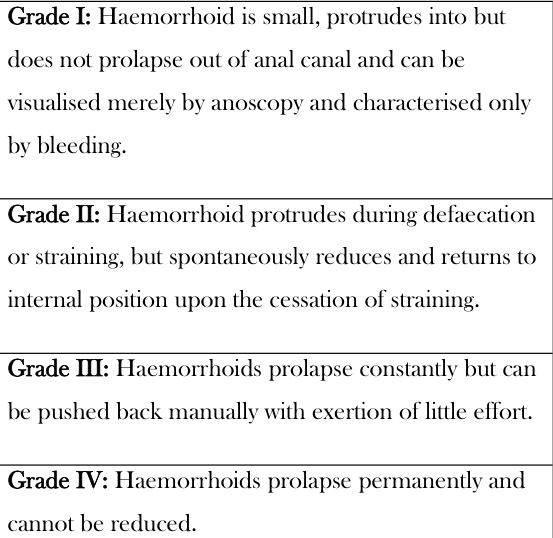
surgical procedure performed. Based on the physical
examination, the hemorrhoids were classified into 4
groups according to the extent of symptoms (Table
1).
Table 1 Classification of hemorrhoids according to severity of
physical examination findings
In our study acute hemorrhoidal disease was defined
as acute thrombosis of external hemorrhoids,
prolapsus and strangulation of internal hemorrhoids,
that trombozed, ulcerated or were gangrenous.
Obstetrics and neonatal pediatric departments were
consulted before surgical intervention. The patients
who underwent minimally invasive procedures such
as hemorrhoid ligation (suture, elastic band;
transanal/endoscopic), hemorrhoidal artery ligation,
sclerotherapy, cryotherapy, monopolar diathermy
(electrocautery) and coagulation, infrared
coagulation and laser coagulation were excluded
from the study.
Statistical Analysis:
SPSS 23.0 package program was used in the statistical
analysis of the data. Categorical measurements were
summarized as numbers and percentages while
continuous measurements were summarized as mean
and standard deviation (median, minimum-
maximum where necessary). In comparing categoric
variables Chi-Square test was utilized. Statistical
significance was taken as value of 0.05 for all tests.
Results:
Thirteen (17.8%) of the female patients who received
surgical treatment were pregnant. All the patients had
hemorrhoidal disease complaints prior to pregnancy.
Eight (61.5%) of the pregnant patients were in third
trimester, 4 (30.7%) were in second trimester, while
only 1 (7.6%) was in first trimester. The most
common presenting complaints were pain and per
rectal bleeding. Mean age of the patients was 30 (20-
40) years, whereas mean body mass index was 27 (23-
36) kg/m 2. All the patients had previous medical
management for the condition at other centers before
applying to our surgical clinic. Seven (53.8%) of the
patients received further medical/conservative
treatment at our center but showed no progress. All
the patients had acute hemorrhoidal disease
preoperatively. Twelve (92.35) patients had acute
hemorrhoidal disease secondary to grade 3 or 4
internal hemorrhoids while 1 (7.6%) patient had acute
thrombosis of external hemorrhoid. Preoperatively
colonoscopy/rectoscopy was perfomed on four
(30.7%) patients and revealed no extra pathology.
The average pregancy duration was 28 (8-40) weeks.
Nine (69.2%) patients had only complicated
hemorrhoid while 4 (30.7%) had fissure in ano co-
existing with the hemorrhoidal disease. Anal fissure
was noted during the surgery in 3 patients (pain and
hemorrhoidal prolapse rendered the pre-surgery
physical examination inadequate) and before surgery
in one patient. Only hemorrhoidectomy (Milligan-
Morgan or Ferguson) was performed on 9 (69.2%),
hemorrhoidectomy and sphincterotomy on 2 (15.3%)
patients, hemorrhoidopexy by Longo procedure on 1
(7.6%) patient while excision of thrombus was
performed on 1 (7.6%) patient. Average length of the
surgical procedure was 30 (10-35) minutes whereas
duration of the hospital stay was on average 2 (1-3)
days. The one patient who underwent Longo
procedure developed ileus. The patient was re-
examined under general anesthesia which revealed
the cause of delayed bowel movement as partial
stapling of the lumen. Dilatational digital rectal
examination was done to release the stapled
contralateral mucosa. Spontaeous passage of the stool
occured after the dilatation. During the early
postoperative period, 11 (84.6%) patients complained
of excessive pain while ileus was observed in 1 (7.6%)
patient. No other early or late complications occured.
Discussion
Hemorrhoidal disease affects 4-40% of the
population with equal prevalence among male and
female. However, it is believed that there is a surge in
prevalence among pregnant women reaching 85% in
second and third trimesters
4-7. Constipation, history of
perianal disease, birth weight of the baby greater than
3000g, and prolonged labor contribute to the
increased risk for postpartum hemorrhoidal disease
8.
Pregancy is a physiological process that affects
hemorrhoids. Constipation and hormonal venous
dilations contribute to the high rates of hemorrhoidal
disease that reach 38% during pregnancy
9. In our
study the rate of surgical intervention for
hemorrhoidal disease in pregnant women was 17.8%.
In comparison with literature, this rate is above the
reported general poulation figures for hemorrhoid
surgey carried out at other centers during pregnancy
while the total number of the patients (male and
female) who received surgery for hemorrhoidal
disease is relatively low. We attribute this discrepancy
to the fact that our center is a regional referral
hospital.
Pregnancy is a process that causes formation of
hemorrhoids or exacerbates symptoms of pre-existing
hemorrhoidal disease
10. Pressure exerted on the
vasculature by growing uterus and relaxation effects of
the progesterone hormone on the smooth muscles
contribute to the increased hemorrhoidal disease
during pregnancy. Morever, relaxation of the
intestinal muscles caused by the hormones leads to
reduced bowel movements and constipation in
pregnancy. Pregnancy related vomiting and fluid loss
lead to hard stool formation that causes straining
when passing stool, resulting in prolapsed and
complicated hemorrhoids. Besides causing
hemorrhoidal disease, constipation complicates
hemorrhoidal disease and exacerbates symptoms
together with other contributing factors. Furthermore,
pushing and straining during labor worsen the clinical
conditions and result in prolonged symptoms after
delivery
11.
The clinical symptoms and the signs of the disease are
similar with those of non-pregnant population.
Painless red per rectum bleed, prolapse that becomes
manifest with defecation, sneezing, coughing or
walking, anal pruritis and chronic irritation caused by
dampness, pain due to acute thrombosis or
irreducible prolapse, feeling of perineal and anal
engorgement, tenesmus and rectal discharge, and
impaired bowel functions are some manifestations of
the hemorrhoidal disease
5.
Pregnancy and puerperium are the two most
important factors that contribute to the symptomatic
hemorrhoidal disease which is a very important
anorectal region disorder. The symptoms of the
hemorrhoidal disease are generally common in
second and third trimesters and after delivery
5. In our
study 12 (92.3%) of the patients were in second and
third trimesters. One patient received surgical
intervention for acute hemorrhoidal disease during
the first trimester. This patient had a 10 year prior
history of hemorrhoidal disease.
The aim of hemorrhoidal disease treatment during
pregnancy is to alleviate acute and chronic symptoms,
prolong period between attacks, and protect perineal
region. Any medical or surgical treatment planned
should pose no harm to the mother and the fetus and
should at the very least relieve the symptoms the
patient until the end of the puerperium.
During pregnancy, the treatment is primarily geared
to manage the symptoms, especially to relieve pain.
Non-surgical treatment modalities are dietary
changes, use of drugs that regulate bowel movements,
and use of local therapy and phlebotonic drugs (drugs
used in venous insufficiency that target
microcirculation to reduce cappilary fragility). In most
cases, the symptoms spontaneously taper off or
completely disappear after delivery. For this reason,
surgery for hemmorrhoidal disease which is not
acute, should be postponed till after delivery in order
to protect the mother and fetus. Symptoms of the
internal hemorrhoids mostly respond to medical
treatment. In the abscence of thrombosis surgical
treatment for external hemorrhoids should also be
postponed until the delivery.
Failure of medical and conservative treatment is an
indication for surgical intervention. Because of
increased potential risk from surgery, surgeons shy
away from operating on pregnant women even when
the symptoms like pain persist despite
medical/conservative treament
5. Surgical intevention
can cause bleeding that carries a risk of hypotension
(3.3-6.7%) for the mother and the fetus
12. Moreover,
sphincterotomy procedure performed with or without
hemorrhoidectomy may induce labor or cause
intractable wounds. Taking these risks into account,
conservative/medical therapy should be preferred. In
our study the 13 patients had no postoperative
bleeding complications while also the
sphincterotomy patients had no complications of
labor induction or problems of wound healing.
If the patient has ulceration, profuse bleeding, anal
fissure or fistule accompanying prominently
prolapsed hemorrhoids and is not responding to
medical/conservative treatment hemorrhoidectomy is
a more effective option to manage the disease. But,
with the use of adequate and precise medical therapy
surgery is rarely necessary. Hemorrhoidectomy is
necessary in external hemorrhoids with recurrent
thrombosis or internal hemorrhoids that irreducably
prolapse and is not responsive to band ligation or are
persistently bleeding. Hemorrhoidectomy is
performed under general anesthesia and may require
in-patient treatment. Thrombosed external or
prolapsed internal hemorrhoid may require surgery.
During hemorrhoidectomy only symptomatic
hemorrhoids should be excised to avoid unnecessary
risk to the mother and the fetus. In our study one
patient had hemorrhoid excision for thrombosed
external hemorroid. The patient had no
complications.
Pain, urinary retention and hemorrhage are most
important early complications encountered after
hemorrhoidectomy while hemorrhage, anal stenosis
and incontinence are late complications
13-15. In our
study 11 patients (13 patients, 11
hemorrhoidectomies, 1 hemorrhoidopexy and 1
thrombectomy) who had hemorroidectomy
(Milligan-Morgan or Ferguson) experienced early
postoperative pain for an average of 4 (2-7) days. This
was attributed to the fact that most patients had
advanced disease with severe complications.
Hemorrhoidopexy technique has gained popularity
over the years as an alternative that reduces
postoperative pain and increases patient satisfaction
16.
The proposed theoretical advantages of this
technique over conventional methods are less pain as
the surgical site is away from the anoderm rich in pain
receptors, hence shorter hospital stay. Even though
early studies have fronted this technique as
advantageous because of less postoperative pain and
high patient satisfaction rates, in recent years
application of Cochrane methodology to assess the
data have shown that the tecnhique is not as effective
as fronted and has high rates of reccurence, increased
risk of rectal prolapse and increased hemorrhoidal
disease symptoms
17-19. The single hemorrhoidopexy
patient in our study complained of severe pain that
subsided after postoperative day 2. But, that patient
also had a rare complication of contralateral mucosa
being stapled together during surgery and subsequent
ileus. The patient was re-examined under anesthesia
on postoperative day 2 during which digital rectal
exam was performed to release the staples and dilate
the canal. After the procedure unhindered passage of
the stool was observed. The patient was discharged
the following day and the follow-up was
unremarkable. The single thrombectomy patient had
no complaint of pain. In total 11 (84.6%) patients had
complaints of pain as early complication, while 1
(7.6%) developed ileus. We did not observe other
early or late procedure-associated complications.
There is a known standard treatment algorithm for
hemorrhoidal disease which is common in the
society. However, in special conditions like
pregnancy where surgery carries potential risks for the
mother and the fetus, this standard algorithm can be
altered. Because of the potential surgical risks, most
clinics insist on medical/conservative treatment to the
last tolerable point (when the hemorrhoids
thombose, intractably prolapse and show ulcerations
or necrosis). Surgeons are mostly caught in a thin
sensitive line between medical and social implications
of the complicated hemorrhoidal disease and
mothers’ genuine worries, psychological and
emotional processes when faced with surgery.
Because of this, by the time those mothers present for
the surgery as a last resort, they would have gone from
doctor to doctor and tried all conservative and
alternative therapy means. The fact that the 13
patients in this study agreed and consented to the
surgery in the face of the risks that anesthesia poses to
the fetus and themselves, is a clear indication that the
condition of their hemorrhoidal disease is intolerable.
The firstline therapy for hemorrhoidal disease during
pregnancy should be medical/conservative therapy.
But for the patients presenting with acute
hemorrhoidal disease, surgical intervention can be
applied with minimal risk of complications at centers
with adequate surgical, anesthetic and technical
capabilities.
Details of ethics approval
This study was approved by Baskent University
Institutional Review Board (Project no: KA 18/101)
and supported by Baskent University Research Fund.
The authors report no conflicts of interest. The
authors alone are responsible for the content and
writing of the paper.
Funding
The study did not receive any funding.
Declarations
Declaration of interest:
References
- Füzün M. Anorektal Benign Hastalıklar. Klinik Gastroenteroloji ve Hepatoloji. 2007.
- Place R, Hyman N, Simmang C, et al. The standart task force the ASCRS. Dis Colon Rectum. 2003;46:573-6.
- Creasy RK, Resnik R. Maternal fetal medicine. Philadelphia: WB saunders; 1984.
- Wolff BG. Pemberton JH, Wexner SD, et al. Hemoroidal Disease. The ASCRS Textbook of Colon and Rektal Surgery. 2007.
- Avsar AF, Keskin HL. Haemorrhoids during pregnancy. J Obstet Gynaecol. 2010;30:231-7.
- Mirhaidari SJ, Porter JA, Slezak FA. Thrombosed external hemorrhoids in pregnancy: a retrospective review of outcomes. Int J Colorectal Dis. 2016;8:1557-9.
- Gojnic M, Dugalic V, Papic M, et al. The significance of detailed examination of hemorrhoids during pregnancy. Clin Exp Obstet Gynecol. 2005;32(2):183-4.
- Poskus T, Buzinskienė D, Drasutiene G, et al. Haemorrhoids and anal fissures during pregnancy and after childbirth: a prospective cohort study. BJOG. 2014;121:1666-71.
- Calhoun BC. Gastrointestinal disorders in pregnancy. Obstet Gynecol Clin North Am.1992;19:733-44.
- Hussain JN. Hemorrhoids. Prim Care. 1999;26:35-51.
- Hodes B. Hemorrhoidal Products. In: Handbook of Nonprescription Drugs, 11th ed. American Pharmaceutical Association. Washington D.C. 1996.
- Ho YH, Foo CL, Seow-Choen F, Goh HS. Prospective randomized controlled trial of a micronized flavonidic fraction to reduce bleeding after haemorrhoidectomy. British Journal of Surgery. 1995;82:1034–5.
- Shanmugam V, Thaha MA, Rabindranath KS, Campbell KL, Steele RJ, Loudon MA. Rubber band ligation versus excisional haemorrhoidectomy for haemorrhoids. Cochrane Database Syst Rev. 2005;20;CD005034.
- Halverson A. Hemorrhoids. Clin Colon Rectal Surg. 2007;20:77–85.
- Saylam B, Özer MV, Polat Düzgün A, et al. The Milligan-Morgan operation in the surgical treatment of hemorrhoids: Survey of 828 cases. Ulusal Cerrahi Dergisi. 2011; 27(1): 31-4.
- Longo A. Treatment of hemorrhoidal disease by reduction of mucosa and hemorrhoidal prolapse with a circular suturing device: a new procedure. Sixth World Congress of Endoscopic Surgery. Rome, Italy. Bologna: Monduzzi Publishing Co; 1998;777-84.
- Jayaraman S, Colquhoun PH, Malthaner RA. Stapled hemorrhoidopexy is associated with a higher long-term recurrence rate of internal hemorrhoids compared with conventional excisional hemorrhoid surgery. Dis Colon Rectum. 2007;50:1297–305.
- Lan P, Wu X, Zhou X, Wang J, Zhang L. The safety and efficacy of stapled hemorrhoidectomy in the treatment of hemorrhoids: a systematic review and metaanalysis of ten randomized control trials. Int J Colorectal Dis. 2006;21:172–8.
- Shao WJ, Li GC, Zhang ZH, Yang BL, Sun GD, Chen YQ. Systematic review and metaanalysis of randomized controlled trials comparing stapled haemorrhoidopexy with conventional haemorrhoidectomy. Br J Surg. 2008;95:147–60.
Copyright & License
This article retains the copyright and licence terms stated at its original publication. The journal's later licensing policy does not replace or amend those terms.
Read the original article PDF for the applicable copyright and reuse terms.