Abstract
Abstract Aim: Although the irinotecan–bevacizumab (IB) combination is a frequently used treatment option in recurrent brain tumors, clinical benefit shows heterogeneity among patient subgroups. This study aimed to evaluate clinical and prognostic factors associated with early-stage mortality and overall survival (OS) in patients receiving IB treatment. Material and Methods: Seventy-eight brain tumor patients who received IB treatment between 2015 and 2023 were retrospectively evaluated. Patients with complete clinical and radiological data were included in the study. The demographic, clinical, and pathological characteristics of the patients were recorded. The timing of the initiation of IB therapy was categorized according to whether it was started at the first recurrence or at the second and subsequent recurrences. Factors associated with early-stage mortality (≤6 months) were determined using log-linear regression analysis, while independent prognostic factors affecting GSK were determined using the Cox proportional hazards regression model. Results: The mean age of patients was 53.01±12.78 years, and the mean follow-up period was 9.47 months. The mortality rate within the first 6 months was determined to be 44.9%. Early-stage mortality was found to be significantly associated with multilobular tumor localization (p=0.037) and initiation of IB therapy at ≥2nd stage (p=0.036). In the log-linear regression analysis, the probability of survival beyond 6 months was 5.05 times lower (RR=0.198, 95% CI: 0.054-0.735) in multilobular localization, while in those who started IB at ≥2nd node, it was 4.40 times lower (RR=0.227, 95% CI: 0.069-0.748). In the multivariate Cox regression analysis, starting IB at ≥2nd line (HR: 2.35, 95% CI: 1.09-5.07, p=0.029), the presence of IDH mutation (HR: 1.98, 95% CI: 1.09-3.58, p=0.025), and age (HR: 1.03, 95% CI: 1.01-1.05, p=0.015) were identified as independent prognostic factors for GSK. Conclusion: This retrospective cohort study based on real-world data demonstrates that the clinical benefit of the IB combination shows significant heterogeneity across patient subgroups. Multilobar tumor location and initiation of IB therapy in the late stages of recurrence are associated with early mortality and poorer survival. Our findings emphasize that IB therapy in recurrent brain tumors should be administered in a personalized manner, considering patient selection and treatment sequence, rather than as a routine approach.
Keywords: Glioblastoma multiforme; brain tumors; bevacizumab; irinotecan; overall survival
1. Introduction
Brain tumors, particularly glioblastoma multiforme (GBM), are associated with high mortality and morbidity and remain a signifi-cant clinical challenge due to their resistance to treatment. GBM is the most common and aggressive type of brain tumor, with high re-currence rates after treatment. Traditional approaches to GBM treatment, such as surgical intervention and radiotherapy, have lim-
Corresponding Author: Mustafa Seyyar, mustafaseyyar27@hotmail.com, Received:
ited effectiveness. In this context, the management of treatment-re-sistant patients poses a major challenge for clinical oncologists, and new treatment strategies need to be developed.
The biological heterogeneity of GBM causes rapid resistance to standard treatments. These characteristics lead to limited treat-ment options, especially in recurrent disease. In recent years, the
27.12.2025, Accepted: 05.03.2026, Available Online Date: 15.03.2026.
No Derivatives License 4.0 (CC-BY-NC-ND), where it is permissible to download and share the work provided it is properly cited. The work cannot be changed in any way or used commercially without permission from the journal.
roles of targeted therapy and immunotherapy in brain tumor treat-ment have been increasingly investigated1,2. However, despite these treatment methods, most patients experience recurrence and over-all survival (OS) times are reduced.
In this context, a better understanding of GBM biology has ne-cessitated the development of combination strategies that could in-crease response rates. The combination of treatment agents such as irinotecan-bevacizumab (IB) is an important option in this field. The vascular structure of GBM and its growth characteristics dependent on angiogenesis make anti-angiogenic treatments a rational target3.
Bevacizumab, as a vascular endothelial growth factor (VEGF) in-hibitor, blocks tumor blood supply and presents an effective treat-ment option for improving the prognosis of treatment-resistant pa-tients with brain tumors4. The use of bevacizumab in GBM aims to improve clinical and radiological response by modulating the tu-mor’s vascular structure. In clinical practice, bevacizumab therapy is frequently preferred in recurrent GBM patients, particularly be-cause it provides rapid symptom control.
However, bevacizumab monotherapy is often insufficient, and combinations with chemotherapy may yield more effective results. In this context, the combination of bevacizumab with chemotherapy agents such as irinotecan offers a promising approach for the treat-ment of resistant patients4,5. It is known that bevacizumab-based therapies in recurrent GBM patients reduce the need for steroids by decreasing peritumoral edema and improve patients’ functional sta-tus6.
Irinotecan is a chemotherapy agent that inhibits DNA replication by targeting the S phase of the cell cycle and is used in the treatment of brain tumors such as GBM4,7. Studies show that the combination of IB may increase the efficacy of treatment in brain tumors such as GBM. The combined use of anti-angiogenic and cytotoxic effects is considered one of the key mechanisms explaining how this combi-nation increases objective response rates in recurrent malignant gli-omas8.
However, more data is needed on the efficacy of this treatment combination, patient clinical responses, and treatment response predictors. There are a limited number of studies in the literature on the long-term responses to this treatment strategy.
In particular, the heterogeneity of the effect on OS among patient groups necessitates a more detailed evaluation of clinical and prog-nostic factors9,10. The limited availability of real-world data makes it difficult to clearly determine in which patient subgroups the IB combination provides greater benefit in clinical practice. Therefore, this study, which retrospectively analyzes the efficacy of the IB com-bination in brain tumors and the factors that may influence OS, aims to provide guiding data for patient selection in the management of brain tumors, particularly recurrent GBM.
2. Materials and Methods
Study Population and Patient Selection This study was designed as a retrospective, observational cohort study that included patients diagnosed with brain tumors and treated with IB between 2015 and 2023. Patients ≥18 years of age with histopathologically confirmed brain tumor diagnosis, complete clinical and radiological follow-up data, and who received IB treat-ment were included in the study. Patients with incomplete clinical data, insufficient follow-up period, or those whose OS status could not be evaluated were excluded from the study. The demographic characteristics, clinical findings, pathological data, and treatment information of all patients were obtained retrospectively from pa-tient files and electronic record systems.
Treatment and Clinical Evaluation The start time of IB treatment was classified according to the
number of disease relapses as treatment initiated at the first recur-rence and treatment initiated at the second or subsequent relapses (≥2nd recurrence). The clinical and radiological responses of the pa-tients were recorded based on the imaging and clinical evaluation results obtained during routine follow-ups.
Table 1
Early period OS-based sociodemographic and clinical characteristics
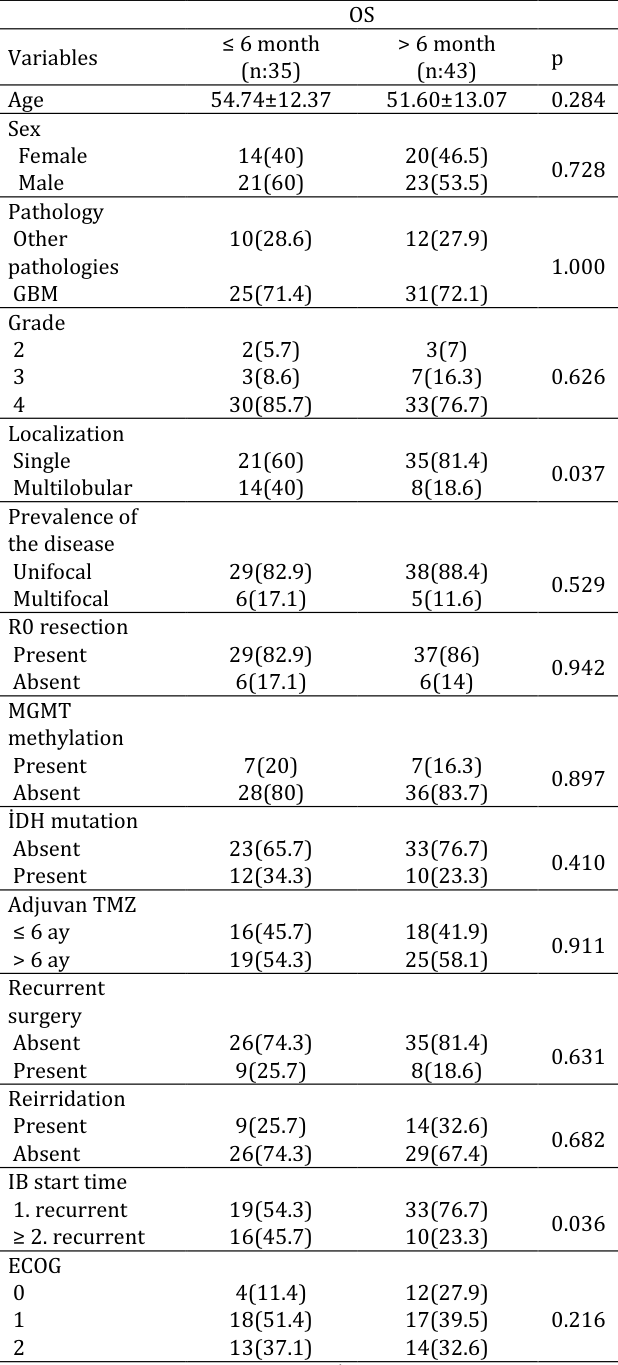
GBM: Glioblastoma multiforme MGMT: O⁶-methylguanine-DNA methyltransferase, IDH: Isocitrate dehydrogenase, TMZ: Temozolomide, IB: Irinotecan-Bevacizumab, OS: Overall survival
Table 2
Log-linear regression interaction analysis for early period mortality
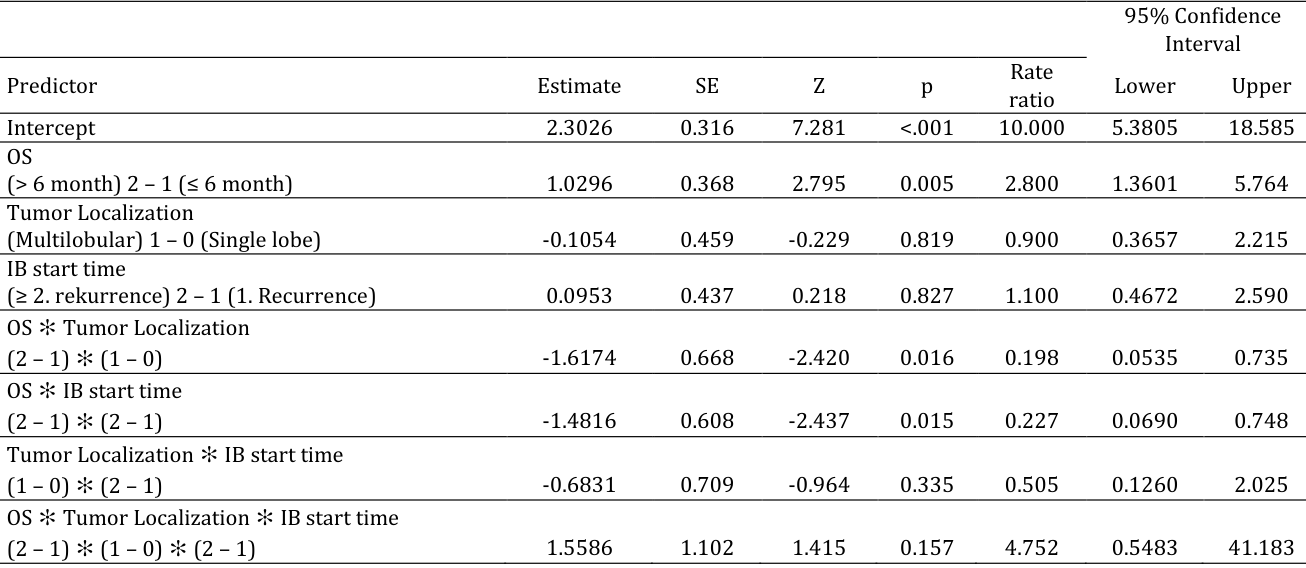
OS: Overall survival, IB: Irinotecan-Bevacizumab
Statistical Analysis Statistical analyses were performed using JAMOVI software (JAMOVI; URL: https://www.jamovi.org, accessed on 01.10.2024). The distribution of continuous variables was assessed using the Shapiro–Wilk test. Data showing a normal distribution were ana-lyzed using parametric tests, while data not showing a normal dis-tribution were analyzed using non-parametric tests. Student’s t-test and chi-square test were used for intergroup comparisons when ap-propriate. Log-linear regression analysis—a method suited to ana-lyze interactions among categorical variables (early mortality sta-tus, tumor localization, and IB initiation timing) by modeling cell fre-quencies in a contingency table under the assumption of multino-mial sampling— and multivariate survival analyses were performed to evaluate factors affecting overall survival. A Cox proportional hazards regression model was created to determine independent prognostic factors affecting overall survival. Variables found to be statistically significant in univariate analysis or considered clinically relevant were included in the multivariate model. Results were pre-sented as hazard ratios (HR) and 95% confidence intervals (CI). A p-value <0.05 was considered statistically significant in all statisti-cal analyses.
3. Results
The mean age of the 78 patients included in our study was 53.01±12.78. The mean follow-up period was 9.47 months (median 7 months, min-max: 0-65). Eighty-four point six percent (n=66) of patients died during the follow-up period. When patients were clas-sified according to early-stage mortality, they were divided into two groups based on GSK status after IB therapy: less than 6 months and greater than 6 months. The mortality rate within the first 6 months was 44.9%. In the comparison based on early-stage mortality, sta-tistically significant differences were found between the groups in terms of tumor localization and time of IB initiation. Multilobar lo-calization and use of IB therapy ≥2nd line were significantly more common in patients who died within the first 6 months (p=0.037 and p=0.036, respectively). No significant differences were ob-
served between the groups in terms of other sociodemographic and clinical characteristics (Table 1).
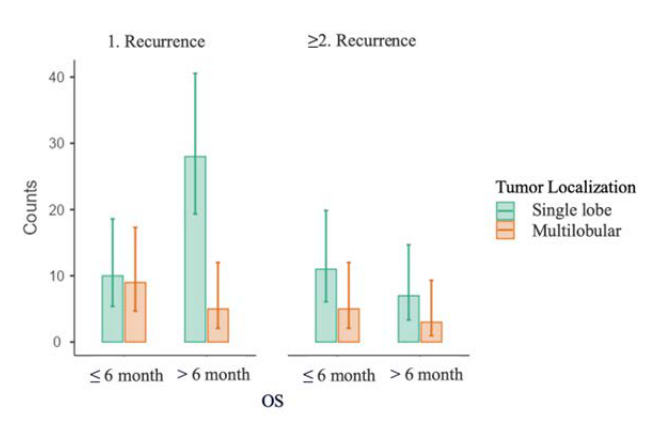
The log-linear regression analysis created to evaluate the inter-action between early-stage mortality and tumor localization and the timing of IB initiation was found to be significant (p<0.001). Patients with multilobular localization had a 5.05-fold lower probability of survival beyond 6 months (RR=0.198, 95% CI: 0.054–0.735). Simi-larly, the interaction between the start time of IB and the duration of mortality was found to be significant; the number of patients sur-viving longer than 6 months was 4.40 times lower in patients who started IB in the second or subsequent relapses (RR=0.227, 95% CI: 0.069–0.748). No significant interaction was found between tumor location, time of IB initiation, and time to mortality (Table 2) (Figure 1).
Figure 1
Estimated marginal numbers for the interaction between tumor location and onset time of IB according to early period mortality
Forest plot representation of multivariate Cox regression analysis for factors affecting OS
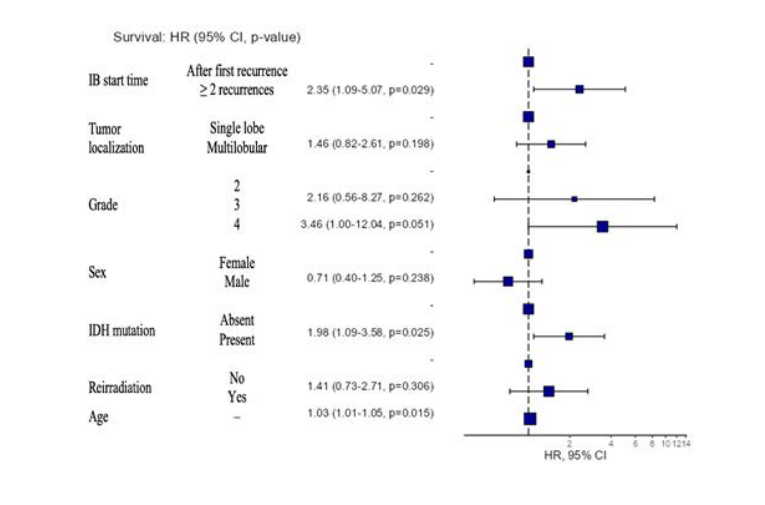
In the multivariate Cox proportional hazards regression analysis, the onset time of IB, the IDH mutation status, and age were found to be independently associated with OS. The squares represent hazard ratios, and the horizontal lines represent 95% confidence intervals.
Table 3
Estimated marginal numbers for the onset time of IB and tumor localization according to early period mortality (log-linear regression model)
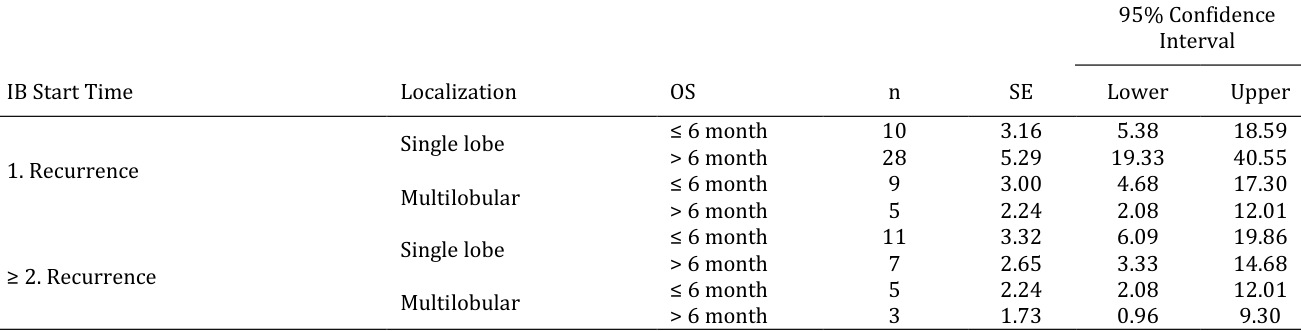
OS: Overall survival, IB: Irinotecan-Bevacizumab
Table 4
Univariate and multivariate Cox proportional hazards regression analysis of factors affecting OS
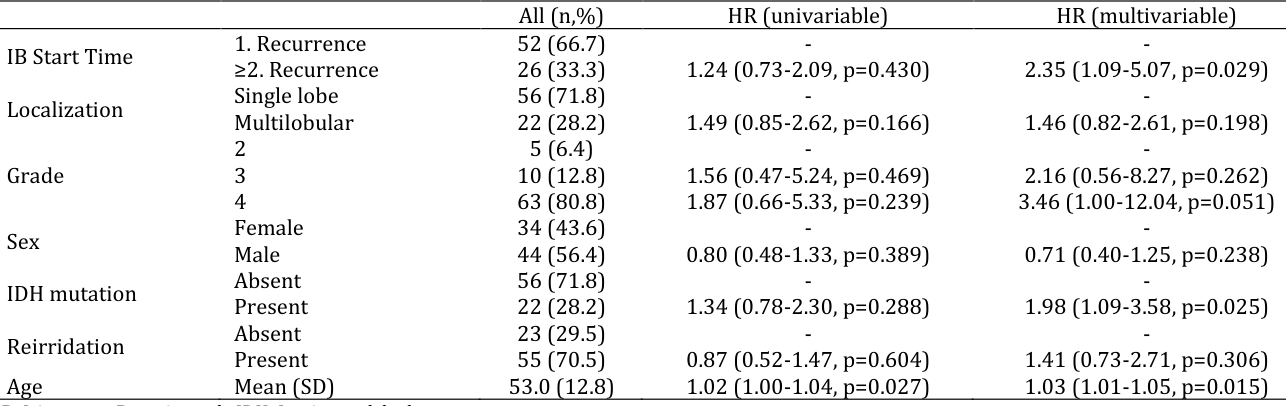
IB: Irinotecan-Bevacizumab, IDH: Isocitrate dehydrogenase
In patients who started IB therapy in the first relapse and had a single-lobe tumor, the number of patients showing OS longer than 6 months was higher compared to other groups (Table 3).
In the OS analysis, the time of IB initiation, the presence of IDH mutation, and age were determined as independent prognostic fac-tors according to the multivariate Cox regression model. The risk of death was 2.35 times higher in patients who received IB in the sec-ond or subsequent relapses (HR: 2.35, 95% CI: 1.09–5.07, p=0.029). The risk of death was 1.98 times higher in patients with IDH muta-tion (HR: 1.98, 95% CI: 1.09–3.58, p=0.025). Each additional year of age was associated with a 3% increase in the risk of death (HR: 1.03, 95% CI: 1.01–1.05, p=0.015) (Table 4).
4. Discussion
Our study Concurrent and adjuvant temozolomide-based therapy with postoperative radiotherapy is the standard treatment for GBM and other high-grade brain tumors. However, due to the risk of recurrence and resistance to treatment, these malignancies have significantly limited survival11. In our study, the high early-stage mortality in cases receiving IB treatment demonstrates the aggressive nature of the disease and the significantly limited clinical efficacy of systemic treatments administered at advanced stages. Although the strong role of markers such as MGMT promoter methylation in response to standard treatment and long-term outcomes is known, treatment selection in cases of recurrence is often related to clinical course, previous treatments, performance status, and disease extent12.
Our study found that early mortality emerged as a clinical entity associated with multilobular tumor location and initiation of IB treatment in second or subsequent relapses. The associated low OS levels indicate aggressive tumor biology and increased clinical fragility. Current classification emphasizes the decisive role of molecular features (IDH, 1p/19q, TERT, EGFR, etc.) in diagnosis and prognosis in diffuse gliomas, highlighting the importance of disease heterogeneity in addition to histology13. In this context, the interpretation that a multilobular pattern of distribution may be associated with higher tumor burden and aggressive behavior, and that initiation of IB therapy at a later stage may reduce the expected survival time, is clinically consistent.
In our study, the evaluation of treatment response based on clinical and imaging data in real-world conditions highlights the importance of response criteria in high-grade gliomas. Due to the inadequacies of classic radiological criteria, RANO criteria have been proposed as an alternative. Accordingly, a more comprehensive response evaluation approach, including clinical status and steroid requirements, has been suggested14. Furthermore, contrast retention may decrease significantly during anti-angiogenic therapies, leading to misleading radiological responses termed “pseudoresponse.” In this context, the increased clinical significance of non-contrast-enhancing tumor components has highlighted the inadequacies of current evaluation criteria and prompted modifications to the RANO criteria15. Therefore, it should be considered that some of the heterogeneous survival outcomes observed in our study may be related to differences in patient selection as well as changes in tumor imaging biology under anti-angiogenic therapy. In bevacizumab-based treatment strategies similar to IB, a significant portion of the clinical benefit arises from symptom control and a reduction in peritumoral edema and steroid requirements, rather than changes in tumor burden. Although large phase III studies evaluating the addition of bevacizumab to standard radiotherapy-temozolomide combination showed prolonged progression-free survival, the OS advantage was reported to be
limited16,17. These phase III data indicate that while anti-angiogenic therapies may increase clinical and radiological response rates, their impact on survival may vary across patient subgroups; thus, patient selection plays a decisive role in real-world data. In our study, the negative prognostic effect of initiating IB in the second or subsequent relapses indicates that bevacizumab-based approaches should be positioned at the appropriate treatment step.
The emergence of age as an independent prognostic factor in multivariate analysis is consistent with current guidelines for adult diffuse gliomas18. Increased comorbidity, treatment tolerance status, and neurocognitive impairment in older age, as well as differences in tumor biology, may negatively affect survival. In this context, the prognostic effect of age is a finding that is consistent with real-world data and expected in our study.
The emergence of agents such as regorafenib in the treatment of recurrent glioma in recent years has opened up a more pronounced debate on the efficacy and scope of bevacizumab-based treatment approaches. The REGOMA randomized phase II study demonstrated a statistically significant OS superiority in favor of regorafenib compared to lomustine19. In this context, the findings of our study indicate that IB should be rationally positioned based on appropriate patient selection and treatment line rather than being applied as a routine treatment approach in “every recurrent patient.”
The relationship between IDH mutation status and survival in our study is noteworthy. Unexpectedly, IDH mutation was associated with poorer OS in our cohort (HR: 1.98, 95% CI: 1.09– 3.58), which stands in contrast to the well-established favorable prognostic role of IDH mutations in diffuse gliomas. This finding should be interpreted with caution and may reflect treatment-line bias, as IDH-mutant tumors tend to occur in younger patients who may have received more extensive prior therapies before IB initiation, thereby entering the recurrent setting with greater treatment burden. Additionally, the limited sample size of this study precludes definitive conclusions regarding this association, and it may not be generalizable. Classical studies have shown that IDH1/2 mutations are a fundamental event in the biology of gliomas and play an important role in prognostic classification, particularly in the diffuse glioma spectrum20.
The main limitations of this study are its retrospective design and the limited number of patients. Nevertheless, our real-world cohort provides practical insights that may contribute to patient selection in recurrent brain tumors by revealing the relationship between easily accessible clinical parameters, such as multilobar location and the initiation of adjuvant therapy, and early mortality and survival.
5. Conclusions
In conclusion, this retrospective cohort study demonstrates that the efficacy of the IB combination in recurrent high-grade gliomas, predominantly GBM, is heterogeneous and that clinical benefit varies considerably depending on patient selection, relapse stage, and disease extent. Initiating IB therapy in the second or subsequent relapse and the presence of multilobar disease were associated with poorer survival, while age and molecular characteristics also carry prognostic significance. Our findings emphasize the need to evaluate IB therapy in recurrent brain tumors within the framework of an individualized approach and pave the way for prospective, larger-scale studies.
Statement of ethics The study was conducted in accordance with the principles of the
Declaration of Helsinki and received ethical approval from the Kocaeli University Ethics Committee with the number GOKAEK-2024/20/17 and project code 2024/492.
genAI No artificial intelligence-based tools or generative AI technologies were used in this study. The entire content of the manuscript was originally prepared, reviewed, and approved by both authors.
Funding This research received no specific grant from any funding agency in the public, commercial, or not-for-profit sectors.
Conflict of interest statement The authors declare that they have no conflict of interest.
Availability of data and materials The datasets used and/or analyzed during the current study are available from the corresponding author upon reasonable request.
Declarations
Author Contributions: MS: Study design, research, article writing, PCŞ: Data collection, research, AK: Research, article editing, BM: Statistics, article editing, article writing, TK: Statistics, article editing, article writing, AK: Research, article editing, MU: Research, article editing, TŞ: Research, article editing, MY: Data collection, research, YBT: Research, article editing, DÇ: Research, article editing, UK: Research, article editing, KU: Research, article editing
References
- Lim M, Xia Y, Bettegowda C, Weller M. Current state of immunotherapy for glioblastoma. Nat Rev Clin Oncol. 2018;15(7):422-442. Crossref
- Weller M, Wick W, Aldape K, Brada M, Berger M, Pfister SM, et al. Glioma. Nat Rev Dis Primers. 2015;1:15017. Crossref
- Jain RK, di Tomaso E, Duda DG, Loeffler JS, Sorensen AG, Batchelor TT. Angiogenesis in brain tumours. Nat Rev Neurosci. 2007;8(8):610-622. Crossref
- Ferrara N, Hillan KJ, Gerber HP, Novotny W. Discovery and development of bevacizumab, an anti-VEGF antibody for treating cancer. Nat Rev Drug Discov. 2004;3(5):391-400. Crossref
- Jakobsen JN, Hasselbalch B, Stockhausen MT, Lassen U, Poulsen HS. Irinotecan and bevacizumab in recurrent glioblastoma multiforme. Expert Opin Pharmacother. 2011;12(5):825-833. Crossref
- Friedman HS, Prados MD, Wen PY, Mikkelsen T, Schiff D, Abrey LE, et al. Bevacizumab alone and in combination with irinotecan in recurrent glioblastoma. J Clin Oncol. 2009;27(28):4733-4740. Crossref
- Raymond E, Faivre S, Chaney S, Woynarowski J, Cvitkovic E. Cellular and molecular pharmacology of oxaliplatin. Mol Cancer Ther. 2002;1(3):227-235.
- Vredenburgh JJ, Desjardins A, Herndon JE 2nd, Dowell JM, Reardon DA, Quinn JA, et al. Phase II trial of bevacizumab and irinotecan in recurrent malignant glioma. Clin Cancer Res. 2007;13(4):1253-1259. Crossref
- Taal W, Oosterkamp HM, Walenkamp AM, Dubbink HJ, Beerepoot LV, Hanse MC, et al. Single-agent bevacizumab or lomustine versus a combination of bevacizumab plus lomustine in patients with recurrent glioblastoma (BELOB trial): a randomised controlled phase 2 trial. Lancet Oncol. 2014;15(9):943-953. Crossref
- Ostrom QT, Cioffi G, Gittleman H, Patil N, Waite K, Kruchko C, et al. CBTRUS Statistical Report: Primary Brain and Other Central Nervous System Tumors Diagnosed in the United States in 2012-2016. Neuro Oncol. 2019;21(Suppl 5):v1-v100. Crossref
- Stupp R, Mason WP, van den Bent MJ, Weller M, Fisher B, Taphoorn MJB, et al. Radiotherapy plus concomitant and adjuvant temozolomide for glioblastoma. N Engl J Med. 2005;352(10):987-996. Crossref
- Hegi ME, Diserens AC, Gorlia T, Hamou MF, de Tribolet N, Weller M, et al. MGMT gene silencing and benefit from temozolomide in glioblastoma. N Engl J Med. 2005;352(10):997-1003. Crossref
- Louis DN, Perry A, Wessling P, Brat DJ, Cree IA, Figarella-Branger D, et al. The 2021 WHO Classification of Tumors of the Central Nervous System: a summary. Neuro Oncol. 2021;23(8):1231-1251. Crossref
- Wen PY, Macdonald DR, Reardon DA, Cloughesy TF, Sorensen AG, Galanis E, et al. Updated response assessment criteria for high-grade gliomas: response assessment in neuro-oncology working group. J Clin Oncol. 2010;28(11):1963-1972. Crossref
- Ellingson BM, Wen PY, Cloughesy TF, Abrey LE, Chang SM, Lamborn KR, et al. Modified Criteria for Radiographic Response Assessment in Glioblastoma Clinical Trials. Neurotherapeutics. 2017;14(2):307-320. Crossref
- Chinot OL, Wick W, Mason W, Henriksson R, Saran F, Nishikawa R, et al. Bevacizumab plus Radiotherapy-Temozolomide for Newly Diagnosed Glioblastoma. N Engl J Med. 2014;370(8):709-722. Crossref
- Gilbert MR, Dignam JJ, Armstrong TS, Wefel JS, Blumenthal DT, Vogelbaum MA, et al. A Randomized Trial of Bevacizumab for Newly Diagnosed Glioblastoma. N Engl J Med. 2014;370(8):699-708. Crossref
- Weller M, van den Bent M, Preusser M, Le Rhun E, Tonn JC, Minniti G, et al. EANO guidelines on the diagnosis and treatment of diffuse gliomas of adulthood. Nat Rev Clin Oncol. 2021;18(3):170-186. Crossref
- Lombardi G, De Salvo GL, Brandes AA, Eoli M, Rudà R, Faedi M, et al. Regorafenib compared with lomustine in patients with relapsed glioblastoma (REGOMA): a multicentre, open-label, randomised, controlled, phase 2 trial. Lancet Oncol. 2019;20(1):110-119. Crossref
- Yan H, Parsons DW, Jin G, McLendon R, Rasheed BA, Yuan W, et al. IDH1 and IDH2 mutations in gliomas. N Engl J Med. 2009;360(8):765-773. Crossref
Copyright & License
This article retains the copyright and licence terms stated at its original publication. The journal's later licensing policy does not replace or amend those terms.
Read the original article PDF for the applicable copyright and reuse terms.