Abstract
Aim: Acetabular liner orientation has been widely studied in the context of instability and impingement after total hip arthroplasty (THA), yet its impact on postoperative hip range of motion (ROM) remains unclear. ROM may be influenced by multiple confounding factors, including limb length discrepancy (LLD), femoral offset, body mass index (BMI), smoking status, and soft-tissue procedures. Methods: This retrospective study included 92 hips that underwent primary THA with either a posterosuperior or posterior liner orientation. Demographic, radiographic, and surgical variables—including LLD, femoral offset, bursal repair, and postoperative drain output—were recorded. Hip ROM (flexion, abduction, internal and external rotation) was measured goniometrically at final follow-up. Correlation analyses and multivariable linear regression models were used to evaluate independent predictors of ROM. Results:Mean ROM did not differ significantly between the posterosuperior (n = 61) and posterior (n = 31) liner groups. LLD was independently associated with reduced flexion and external rotation. Abduction and internal rotation were positively associated with bursal repair and greater drain output, whereas higher BMI showed a trend toward reduced abduction. Smoking demonstrated a statistical association with higher abduction values, although this was likely confounded by patient characteristics. Overall, ROM variation was more strongly related to LLD and soft-tissue–related surgical factors than to liner orientation. Conclusion:Liner orientation (posterosuperior vs. posterior) did not significantly influence postoperative ROM after THA. Postoperative mobility was primarily determined by LLD and soft-tissue management. Surgical planning should prioritize correction of LLD and optimization of soft-tissue balance rather than relying on liner orientation to improve ROM.
Keywords: Total hip arthroplasty; liner orientation; hip range of motion
1. Introduction
Total hip arthroplasty (THA) is a widely preferred surgical pro-cedure for achieving effective pain control and functional improve-ment in patients with hip osteoarthritis and other degenerative hip disorders.1 In addition to enabling pain-free ambulation and the ability to perform daily activities, an adequate hip range of motion (ROM) is also critically important for postoperative patient satisfac-tion.2, 3 In particular, limitations in flexion and abduction may ad-versely affect patients subjective assessments by hindering daily ac-tivities such as sitting and standing, putting on shoes, and picking up objects from the floor.
Following THA, hip range of motion is influenced by multiple fac-tors related both to the patient and to the surgical procedure. Radi-ological parameters such as prosthesis design, the positioning of the acetabular and femoral components, femoral offset, and limb length discrepancy (LLD) can all affect postoperative hip mobility.4 Addi-tionally, the manner in which the capsule and surrounding soft tis-sues are balanced, as well as supplementary procedures performed
Corresponding Author: Hilmi Alkan, hilmi_alkan@hotmail.com, Received:
during surgery (such as bursectomy or bursal repair), may also con-tribute to variations in postoperative range of motion.5 Moreover, patient-related factors such as body mass index (BMI), smoking sta-tus, and age may influence both the technical complexity of the pro-cedure and the postoperative healing and rehabilitation process, thereby affecting hip range of motion and daily activity levels after surgery.6
The positioning and orientation of the acetabular component play a decisive role in dislocation risk, the development of impinge-ment, and the achievable arc of motion.4 Although the inclination and anteversion angles of the acetabular cup have been extensively discussed in numerous studies, the influence of liner (insert) orien-tation such as posterosuperior or posterior positioning on hip range of motion and functional outcomes has been comparatively less in-vestigated.7, 8 The orientation of the insert is considered a factor that may influence flexion and abduction arcs, particularly due to its po-tential relationship with posterior soft-tissue impingement and its
08.12.2025, Accepted: 13.02.2026, Available Online Date: 15.03.2026.
No Derivatives License 4.0 (CC-BY-NC-ND), where it is permissible to download and share the work provided it is properly cited. The work cannot be changed in any way or used commercially without permission from the journal.
ability to alter femoroacetabular contact patterns.9, 10 However, the available evidence remains limited, and the mechanisms through which liner orientation may influence postoperative range of mo-tion and functional outcomes are not yet clearly understood.
On the other hand, the factors that determine hip ROM are often interrelated and overlapping. For example, radiological parameters such as LLD and femoral offset may vary in conjunction with the sur-geon’s component placement preferences and the selected insert orientation; likewise, patient characteristics can influence both sur-gical planning and postoperative rehabilitation potential.11-13 Therefore, when evaluating the potential effect of liner orientation on hip ROM, there is a need for multivariable analyses that simulta-neously account for factors such as LLD, femoral offset, BMI, smok-ing status, bursal repair procedures, and drain output. In the current literature, only a limited number of studies have examined the rela-tionship between liner orientation and postoperative hip range of motion including flexion, extension, abduction, adduction, and rota-tional movements while adjusting for these potential confounding variables, particularly with respect to flexion and abduction limita-tions.
The primary aim of this study is to evaluate the effect of pos-terosuperior versus posterior liner positioning on hip range of mo-tion following total hip arthroplasty. The secondary aim is to inves-tigate the relationship between postoperative hip ROM and various patient- and surgery-related factors including age, LLD, femoral off-set, BMI, smoking status, and bursal repair using multivariable lo-gistic regression models.
2. Materials and Methods
Patient Selection This single-center, retrospective observational study included consecutive patients who underwent primary THA at the Orthopae-dics and Traumatology Department of Ankara Bilkent City Hospital between 2021 and 2022. All procedures were performed by the same surgical team using a posterior approach, with the same type of acetabular component and a polyethylene liner. Exclusion criteria comprised revision THA, bilateral THA, or a history of major hip sur-gery on the index side; neuromuscular disorders, significant de-formity, or advanced contracture; as well as postoperative infection, periprosthetic fracture, or any other complication that could impair clinical evaluation. Patients with a minimum of one year of clinical and radiological follow-up were included in the final analysis.
Data extracted from patient records and operative notes in-cluded age, sex, laterality (right/left), body mass index (BMI, kg/m²), smoking status (1 = yes, 0 = no), postoperative drainage vol-ume in the first 24 hours (mL), trochanteric bursal repair (1 = yes, 0 = no; randomized allocation), and liner orientation (posteri-or/posterosuperior). All variables were recorded according to pre-defined criteria and were checked for internal consistency prior to inclusion in the analysis. The study protocol was approved by the Local Ethics Committee (Approval No. E1-23-3379), and the re-search was conducted in accordance with the principles of the Dec-laration of Helsinki.
Surgical Technique and Liner Orientation All procedures were performed by a single surgeon and the same operative team using a standardized surgical technique. The acetabular component was implanted using a press-fit technique to achieve mechanical stability and adequate coverage. The polyeth-ylene liner was then positioned either in a posterosuperior or pos-terior orientation, based on intraoperative assessment of hip stabil-ity and range of motion. Trochanteric bursal repair was assigned in a randomized manner, and the postoperative drainage volume dur-ing the first 24 hours was recorded.
Clinical Evaluation and Range of Motion Assessment All patients underwent a standardized orthopedic examination protocol during their final outpatient follow-up visit. Hip ROM was assessed by the same clinician using a handheld goniometer, and measurements for flexion, extension, abduction, adduction, internal rotation, and external rotation were recorded in degrees.
In the analytical phase of the study, these range-of-motion meas-urements were evaluated both as continuous variables and as cate-gorical variables generated using clinically meaningful threshold values.
Radiological Evaluation Standard radiographic measurements were performed using an-teroposterior pelvic radiographs obtained at the final postoperative follow-up. LLD (mm) was calculated by comparing the perpendicu-lar distances from the inter-teardrop line to the most prominent point of the lesser trochanter on each side; positive values indicated lengthening on the operated side, whereas negative values indicated shortening. Femoral offset (mm) was measured as the perpendicu-lar distance from the center of the femoral head to the longitudinal axis of the femoral shaft. All radiographic assessments were con-ducted by an experienced orthopedic surgeon who was blinded to the study groups.
Statistical Analysis Statistical analyses were performed using SPSS version 25.0 (Chicago, IL, USA). The distribution of continuous variables was as-sessed using the Shapiro–Wilk test and visual inspection; normally distributed variables were presented as mean ± SD, non-normally distributed variables as median (min–max), and categorical varia-bles as number (%). Between-group comparisons were conducted using the independent-samples t-test or the Mann–Whitney U test for continuous variables, and the chi-square test or Fisher’s exact test for categorical variables. Associations between ROM measures and quantitative variables were examined using Spearman correla-tion analysis. Univariable and multivariable logistic regression mod-els were constructed for each hip range of motion parameter, in-cluding flexion, abduction, internal rotation, and external rotation. The results were reported as odds ratios (ORs) with corresponding 95% confidence intervals (CIs) and p-values. All tests were two-tailed, with statistical significance set at p < 0.05.
3. Results
Patient Characteristics A total of 92 hips that underwent primary total hip arthroplasty were included in the study. The posterosuperior liner orientation group comprised 61 hips, whereas the posterior group comprised 31 hips. The two groups were comparable in terms of mean age, laterality (right/left), sex distribution, smoking status, femoral offset, and the frequency of bursal repair, with no statistically significant differences observed for these variables (all p > 0.05). In contrast, BMI and limb LLD were significantly lower in the posterior liner group compared with the posterosuperior group (p = 0.004 and p = 0.001, respectively). Drain output within the first 24 hours was also lower in the posterior group, and the difference between the groups was statistically significant (p = 0.041). Detailed demographic and clinical characteristics of the study groups are presented in Table 1.
Association Between Hip Range of Motion and Risk Factors Associations between hip range of motion and clinical or radiological variables were assessed using Spearman correlation analysis (Table 2). Flexion range of motion demonstrated a weak but statistically significant positive correlation only with smoking status (r = 0.239, p = 0.020). In contrast, no statistically significant correlations were observed between flexion and age, BMI, LLD,
femoral offset, drain output, bursal repair, or liner orientation (all p > 0.05).
Abduction range of motion demonstrated significant correlations with several variables: a negative correlation with body mass index (r = –0.280, p = 0.006), a positive correlation with smoking status (r = 0.313, p = 0.002), and a negative correlation with LLD (r = –0.265, p = 0.010). Accordingly, higher BMI and greater LLD were associated with more restricted abduction, whereas patients who smoked exhibited relatively greater abduction angles. Although age and femoral offset showed trends toward correlation with abduction (p = 0.062 and p = 0.073, respectively), these did not reach the level of statistical significance.
No significant correlations were identified between internal rotation range of motion and any of the examined variables (all p > 0.05), whereas external rotation demonstrated a weak but significant negative correlation only with LLD (r = –0.218, p = 0.036). Liner orientation (posterior vs. posterosuperior) did not show a significant correlation with flexion, abduction, internal rotation, or external rotation in any of the analyses. Detailed results of the correlation analyses are presented in Table 2.
Multivariable Linear Regression Analysis for Hip Range of Motion In the multivariable linear regression analysis, hip range of motion parameters (flexion, abduction, internal rotation, and external rotation) were evaluated as continuous outcomes (Table 3). In the model constructed for flexion, LLD emerged as the only independent and statistically significant predictor; each 1mm increase in LLD was associated with an approximately 0.3° reduction in flexion (p = 0.047). Drain output and posterior liner orientation demonstrated borderline associations with flexion, whereas age, BMI, femoral offset, smoking status, and bursal repair did not show significant effects on flexion.
For abduction, smoking status, greater drain output, and bursal repair were each associated with increased abduction angle after adjustment for other variables (p = 0.023, p = 0.003, and p = 0.009, respectively). BMI and LLD demonstrated borderline trends toward negative effects on abduction, whereas age, femoral offset, and liner orientation were not significant predictors. In the analysis for internal rotation, both drain output and bursal repair showed positive and statistically significant associations with internal rotation angle (p = 0.046 for both), while no other variables reached significance. In the external rotation model, increasing LLD was associated with reduced external rotation, whereas greater drain output was associated with increased external rotation (p = 0.024 and p = 0.026, respectively).
Table 2
Table 1
Demographic data.
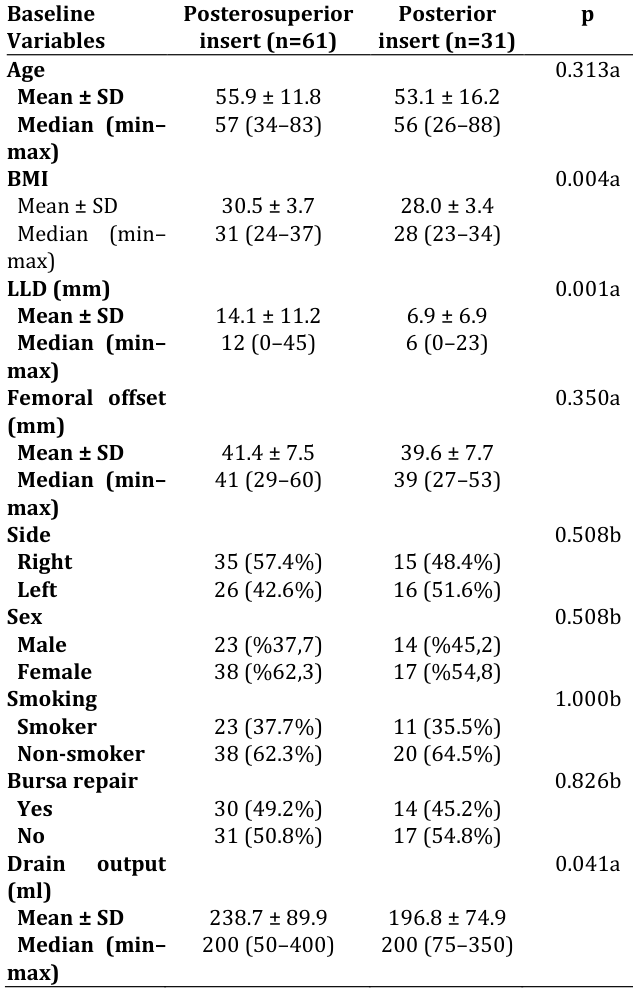
a Mann–Whitney U-test. b Fisher’s exact test.
Correlation between hip range of motion and risk factors (Spearman analysis)
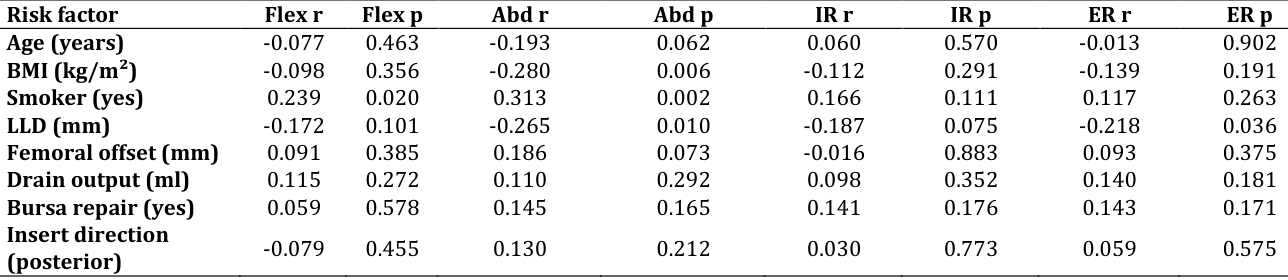
r: Spearman correlation coefficient; p: p-value; Flex: flexion, Abd: abduction, IR: internal rotation, ER: external rotation.
Table 3
Multivariable linear regression analysis of factors associated with hip range of motion after primary total hip arthroplasty
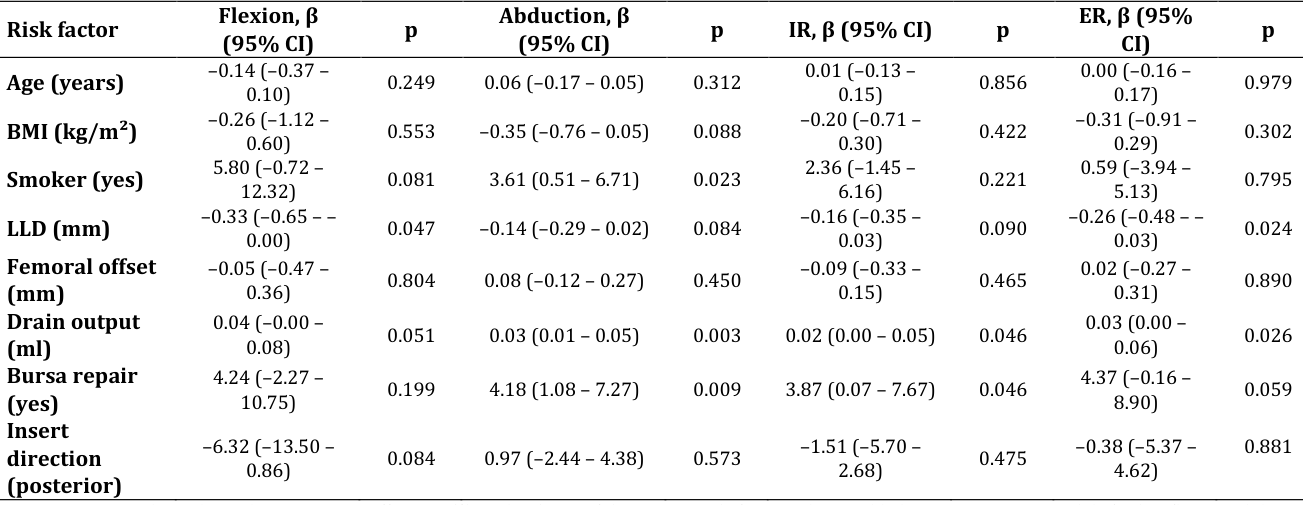
Data are presented as adjusted regression coefficients (β) with 95% confidence intervals from multivariable linear regression models for hip flexion, abduction, internal rotation, and external rotation. Abbreviations: BMI, body mass index; LLD, limb length discrepancy; IR, internal rotation; ER, external rotation.
Overall, these linear regression models indicate that hip ROM is influenced not only by liner orientation but also by limb length discrepancy and soft-tissue–related surgical factors—including drain output, bursal repair, and smoking-associated healing dynamics (Table 3).
4. Discussion
The principal finding of this study is that acetabular liner orientation (posterosuperior vs. posterior) does not result in a clinically meaningful difference in hip range of motion following primary total hip arthroplasty. Postoperative ROM appeared to be more strongly associated with limb length discrepancy and soft tissue related factors such as bursal repair and drain output, rather than with liner orientation itself. These observations suggest that, within the prosthetic configuration examined, global limb alignment and soft-tissue management may serve as more influential determinants of hip mobility than the specific orientation of the liner.
In the existing literature, most studies on acetabular liners have focused on outcomes such as dislocation, impingement, and wear rather than hip range of motion.8, 14-16 Across various series, elevated, ‘lipped,’ or posteriorly raised liner designs have been reported to reduce posterior instability; however, their potential effects on the arc of motion are either not reported or are assessed only indirectly through global functional scores.8, 10 In the available literature, ROM is most often reported as a secondary outcome, and detailed measurements of flexion, abduction, and rotational motion specific to liner orientation are rarely presented. In our study, no significant differences were observed between the posterosuperior and posterior liner groups with respect to mean flexion, abduction, or rotational ROM. This finding suggests that, within the prosthetic configuration used in our cohort, liner orientation may be more closely related to stability and impingement outcomes more prominently emphasized in previous studies than to the range of motion itself.
LLD is one of the most frequently discussed mechanical issues
following total hip arthroplasty and has been associated in numerous studies with limping, altered gait patterns, reduced patient satisfaction, and lower functional scores.17, 18 While some series have reported that radiographic LLD significantly reduces Harris hip scores and patient satisfaction, other studies emphasize that mild discrepancies do not always correspond to measurable functional impairment.18 Gait analysis and biomechanical studies have demonstrated that limb length inequality increases pelvic tilt and torsion, alters hip and knee kinematics on the longer limb, and leads to complex compensatory mechanisms.19-21 In our cohort, the finding that LLD was associated with reduced flexion and external rotation in both correlation analyses and multivariable linear regression models supports these biomechanical observations with corresponding clinical examination data. The observed reductions in flexion and external rotation with increasing LLD can likely be explained by pelvic compensatory mechanisms, alterations in muscle–tendon tension balance, and changes in joint loading patterns.21 Therefore, our study highlights LLD as a fundamental surgical target that should be corrected not only in the context of limping and patient satisfaction but also for the preservation of active hip range of motion.
Although numerous studies have demonstrated that soft-tissue and capsular management influences postoperative pain, stability, and functional outcomes after total hip arthroplasty, the direct effect of procedures such as trochanteric bursal repair on hip range of motion is rarely reported as an independent outcome.22-24 Similarly, the literature on postoperative drain use predominantly focuses on early outcomes such as blood loss, hematoma formation, infection, and wound healing, whereas studies evaluating the relationship between drain output and long-term hip range of motion are virtually nonexistent.25, 26
In this context, our evaluation of bursal repair and drain output within multivariable models alongside hip range of motion partially addresses this gap in the literature. Our findings demonstrated that bursal repair was associated with increased abduction and internal rotation, whereas greater drain output was associated with increased abduction, internal rotation, and external rotation. Rather than indicating a direct ROM-enhancing effect, this pattern suggests
that higher drain volumes may reflect cases in which more extensive soft-tissue release or more meticulous capsular–bursal balancing was performed. These results underscore that postoperative hip ROM is closely influenced not only by component positioning but also by soft-tissue management.
Obesity and elevated BMI have been shown in numerous studies to negatively affect both hip osteoarthritis and postoperative functional outcomes after THA, being associated with lower functional scores and reduced range of motion.27, 28 Smoking, on the other hand, is predominantly associated with adverse outcomes such as impaired wound healing, infection, and an increased risk of revision, and it has not been reported to have a direct positive association with hip range of motion.29, 30 In this context, the trend toward a negative association between BMI and abduction ROM in our cohort is consistent with the existing literature and represents an expected finding. Conversely, the positive association observed between smoking status and abduction (and to a lesser extent flexion) is not biologically plausible and is likely attributable to confounding factors such as younger age, differing activity levels, or other unmeasured patient characteristics among smokers. Therefore, we interpreted this association not as a causal finding with implications for clinical practice, but rather as a statistical observation emerging from the multivariable model that should be approached with caution.
In the literature, acetabular liner orientation is discussed predominantly in the context of dislocation, impingement, and wear, whereas studies that evaluate ROM as a primary outcome and examine liner orientation within multivariable models remain quite limited.9, 31 In our cohort, no significant differences were observed in mean hip range of motion between posterosuperior and posterior liner orientations; instead, ROM appeared to be more closely associated with factors such as LLD and soft-tissue related surgical details, including bursal repair and drain output. These findings suggest that, within the prosthetic and surgical configuration used in our study, liner orientation is not a primary determinant of postoperative hip ROM. Rather, postoperative mobility seems to depend more on LLD and soft-tissue balancing, indicating that liner orientation may be more appropriately considered a secondary parameter in the context of stability and impingement rather than ROM.
Limitations
This study has several limitations. First, the retrospective design and the relatively small sample size particularly in the posterior liner group may reduce statistical power and limit generalizability. Second, hip range of motion was assessed at a single postoperative time point using goniometric examination, and objective functional tests or patient-reported outcome measures were not included in the analysis. Finally, because liner orientation was determined intraoperatively based on the surgeon’s assessment of stability, the potential for selection bias cannot be fully excluded.
5. Conclusions
In this study, acetabular liner orientation (posterosuperior vs. posterior) was not found to produce a significant difference in hip range of motion following primary total hip arthroplasty. The observation that postoperative ROM was more strongly associated with limb length discrepancy and soft-tissue related surgical factors such as bursal repair and drain output suggests that correction of LLD and preservation of soft-tissue balance should be prioritized in THA planning.
Statement of ethics Ethical approval for the study was granted by the Clinical Research Ethics Committee of Ankara City Hospital (Date: 22.03.2023, Number: E1-23-3379).
Funding This research received no specific grant from any funding agency in the public, commercial, or not-for-profit sectors.
Conflict of interest statement The authors declare that they have no conflict of interest.
Availability of data and materials The data and materials of this study are available upon reasonable request.
genAI No artificial intelligence-based tools or generative AI technologies were used in this study. The entire content of the manuscript was originally prepared, reviewed, and approved by both authors.
References
- Liu XW, Zi Y, Xiang LB, Wang Y. Total hip arthroplasty: a review of advances, advantages and limitations. Int J Clin Exp Med. 2015;8(1):27-36. [Crossref]
- Tanaka H, Yamada N, Kurishima H, Mori Y, Sakamoto T, Oyama M. The intraoperative hip range of motion in total hip arthroplasty predicts postoperative patient's satisfaction for cutting toenails and putting on sock. J Orthop Sci. 2022;27(5):1060-6. [Crossref]
- Davis KE, Ritter MA, Berend ME, Meding JB. The importance of range of motion after total hip arthroplasty. Clin Orthop Relat Res. 2007;465:180-4. [Crossref]
- Widmer KH, Zurfluh B. Compliant positioning of total hip components for optimal range of motion. J Orthop Res. 2004;22(4):815-21. [Crossref]
- van Arkel RJ, Ng KCG, Muirhead-Allwood SK, Jeffers JRT. Capsular Ligament Function After Total Hip Arthroplasty. J Bone Joint Surg Am. 2018;100(14):e94. [Crossref]
- Tezuka T, Inaba Y, Kobayashi N, Choe H, Higashihira S, Saito T. The influence of patient factors on femoral rotation after total hip arthroplasty. BMC Musculoskelet Disord. 2018;19(1):189. [Crossref]
- Bhaskar D, Rajpura A, Board T. Current Concepts in Acetabular Positioning in Total Hip Arthroplasty. Indian J Orthop. 2017;51(4):386-96. [Crossref]
- Hau R, Hammeschlag J, Law C, Wang KK. Optimal position of lipped acetabular liners to improve stability in total hip arthroplasty-an intraoperative in vivo study. J Orthop Surg Res. 2018;13(1):289. [Crossref]
- Navacchia A, Pagkalos J, Davis ET. Defining the optimal position of the lipped liner in combination with cup orientation and stem version. Bone Joint Res. 2023;12(9):571-9. [Crossref]
- Hu Y, Zhou X, Qiao H, Zhu Z, Li H, Zhang J. Computer simulation of optimal lipped polyethylene liner orientation against prosthetic impingement. J Orthop Surg Res. 2022;17(1):204. [Crossref]
- McGrory BJ, Morrey BF, Cahalan TD, An KN, Cabanela ME. Effect of femoral offset on range of motion and abductor muscle strength after total hip arthroplasty. J Bone Joint Surg Br. 1995;77(6):865-9. [Crossref]
- Matsushita A, Nakashima Y, Jingushi S, Yamamoto T, Kuraoka A, Iwamoto Y. Effects of the femoral offset and the head size on the safe range of motion in total hip arthroplasty. J Arthroplasty. 2009;24(4):646-51. [Crossref]
- Desai AS, Dramis A, Board TN. Leg length discrepancy after total hip arthroplasty: a review of literature. Curr Rev Musculoskelet Med. 2013;6(4):336-41. [Crossref]
- Takahashi D, Shimizu T, Miyazaki T, Ogawa T, Iwasaki N. Instability in total hip arthroplasty: A literature review. Journal of Joint Surgery and Research. 2023;1(1):92-6. [Crossref]
- Pryce GM, Sabu B, Al-Hajjar M, et al. Impingement in total hip arthroplasty: A geometric model. Proc Inst Mech Eng H. 2022;236(4):9544119211069472. [Crossref]
- Peker G, Bala MM, Altun İ. Ceramic femoral head in highly cross-linked polyethylene cup. 5 year results of a randomized trial. Annali Italiani di Chirurgia. 2022;93(2):202-9. [Crossref]
- Lecoanet P, Vargas M, Pallaro J, Thelen T, Ribes C, Fabre T. Leg length discrepancy after total hip arthroplasty: Can leg length be satisfactorily controlled via anterior approach without a traction table? Evaluation in 56 patients with EOS 3D. Orthop Traumatol Surg Res. 2018;104(8):1143-8. [Crossref]
- Iversen MD, Chudasama N, Losina E, Katz JN. Influence of self-reported limb length discrepancy on function and satisfaction 6 years after total hip replacement. J Geriatr Phys Ther. 2011;34(3):148-52. [Crossref]
- Gurney B. Leg length discrepancy. Gait Posture. 2002;15(2):195-206. [Crossref]
- Resende RA, Kirkwood RN, Deluzio KJ, Cabral S, Fonseca ST. Biomechanical strategies implemented to compensate for mild leg length discrepancy during gait. Gait Posture. 2016;46:147-53. [Crossref]
- Resende RA, Kirkwood RN, Deluzio KJ, Morton AM, Fonseca ST. Mild leg length discrepancy affects lower limbs, pelvis and trunk biomechanics of individuals with knee osteoarthritis during gait. Clin Biomech (Bristol). 2016;38:1-7. [Crossref]
- Fırat A, Veizi E, Karaman Y, et al. Unrepaired Trochanteric Bursae as a Risk Factor for Deep Gluteal Syndrome After Total Hip Arthroplasty: A Prospective Randomized Controlled Trial. J Arthroplasty. 2024;39(4):1025-30. [Crossref]
- Sun X, Zhu X, Zeng Y, et al. The effect of posterior capsule repair in total hip arthroplasty: a systematic review and meta-analysis. BMC Musculoskelet Disord. 2020;21(1):263. [Crossref]
- Chalidis BE, Sachinis NP, Hawdon G, McMahon S. Lateral trochanteric bursa repair improves early hip function after posterior approach total hip arthroplasty: a prospective randomized control trial. Arthroplasty. 2022;4(1):26. [Crossref]
- Erne F, Wetzel S, Wülker N, Gesicki M, Hofmann UK. Closed Suction Drainage after Primary Total Knee Arthroplasty: A Prospective Randomized Trial. J Knee Surg. 2018;31(8):804-10. [Crossref]
- Walmsley PJ, Kelly MB, Hill RM, Brenkel I. A prospective, randomised, controlled trial of the use of drains in total hip arthroplasty. J Bone Joint Surg Br. 2005;87(10):1397-401. [Crossref]
- Vincent HK, Horodyski M, Gearen P, et al. Obesity and long term functional outcomes following elective total hip replacement. J Orthop Surg Res. 2012;7:16. [Crossref]
- Haverkamp D, Klinkenbijl MN, Somford MP, Albers GH, van der Vis HM. Obesity in total hip arthroplasty--does it really matter? A meta-analysis. Acta Orthop. 2011;82(4):417-22. [Crossref]
- Teng S, Yi C, Krettek C, Jagodzinski M. Smoking and risk of prosthesis-related complications after total hip arthroplasty: a meta-analysis of cohort studies. PLoS One. 2015;10(4):e0125294. [Crossref]
- Bojan B, Perni S, Prokopovich P. Systematic Review and Meta-Analysis of Tobacco Use as a Risk Factor for Prosthetic Joint Infection After Total Hip Replacement. Arthroplast Today. 2020;6(4):959-71. [Crossref]
- Cobb TK, Morrey BF, Ilstrup DM. The elevated-rim acetabular liner in total hip arthroplasty: relationship to postoperative dislocation. J Bone Joint Surg Am. 1996;78(1):80-6. [Crossref]
Copyright & License
This article retains the copyright and licence terms stated at its original publication. The journal's later licensing policy does not replace or amend those terms.
Read the original article PDF for the applicable copyright and reuse terms.