Abstract
Introduction: This study examined the prevalence and clinical characteristics of persistent post-Coronavirus Disease 2019 (COVID-19) headache, and explored its associations with demographic, clinical, and neuroimaging parameters within a real-world patient cohort, thereby addressing a frequently reported yet insufficiently understood neurological complication.Materials and Methods: A total of 341 patients with polymerase chain reaction (PCR)-confirmed COVID-19 who presented with persistent symptoms to a neurology outpatient clinic were evaluated. Patients were grouped according to the presence or absence of an ongoing headache. Demographic characteristics, comorbidities, accompanying neurological and systemic symptoms, and neuroimaging findings (including conventional MRI, diffusion-weighted imaging, and MR venography when available) were compared between the groups. Statistical analyses included chi-squared tests, t-tests or non-parametric equivalents for group comparisons, and logistic regression models to identify independent associations between variables.Results: Persistent headache was reported by 36.9% of patients and was significantly more common among younger individuals and women (median age 45 vs. 55 years, p < 0.001; 42.9% vs. 27.5%, p = 0.004). Insomnia (p = 0.002), dizziness (p = 0.01), and myalgia/paresthesia (p = 0.03) were significantly more common in the headache group. In contrast, abnormal neuroimaging findings, including diffusion-weighted imaging (DWI) abnormalities and MR venography pathology, were significantly more frequent in patients without headaches. Among those with abnormal MRI findings, older age, comorbidity burden, and longer hospitalization duration were observed to be present. Multivariate analysis confirmed age and female sex as independent predictors of post-COVID headache.Conclusion:Post-COVID headache has a distinct clinical profile characterized by demographic susceptibility and concurrent dysautonomic or neuroinflammatory symptom clusters. These findings underline the need for focused clinical evaluation and improved understanding of the mechanisms underlying persistent headache during the post-infectious period.
Keywords: COVID-19; Post-Acute COVID-19 Syndrome; Headache; Nervous System Manifestations
1. Introduction
Severe acute respiratory syndrome coronavirus 2 (SARS-CoV-2) manifests through a variety of symptoms, with headaches being the most frequently occurring and persistent symptoms associated with coronavirus disease 2019 (COVID-19). Many studies have investi-gated the prevalence and clinical features of headache following COVID-19 1-2. These headaches often mimic primary headache syn-dromes, such as migraines or tension-type headaches 2. Many pa-tients with COVID-19 experience persistent headaches that persist even after the acute phase of infection has resolved or some-times experience new-onset headaches after the temperature has stabilized 1. Additionally, the severity of headaches tends to increase in the later stages of COVID-19 infection than in the acute phase 3.
The complex nature of how the virus enters the body, attacks it, and the effects it produces underscores the need for detailed re-search to elucidate the symptoms, characteristics, and potential neuroimaging explanations for headaches that occur after COVID-19 infection. In this type of research, a better understanding of the characteristics of headaches that are newly onset, worsen, or persist after a viral epicenter, as well as the specific emergence of COVID-19, is essential for developing treatment methods and achieving bet-
ter outcomes in patients.
This study aimed to evaluate the demographic, clinical, and ra-diological characteristics of the patients. Despite the high preva-lence of post-COVID headache, data on its neuroimaging correlates remain limited and inconsistent. In particular, it is unclear whether persistent headaches are associated with detectable structural or vascular abnormalities on routine neuroimaging or whet-her they primarily reflect nonstructural functional processes.
2. Materials and Methods
This cross-sectional observational study was conducted at the neurology outpatient clinic of a tertiary hospital. Adult patients (≥18 years) with a prior confirmed SARS-CoV-2 infection were evaluated after resolution of the infection. In line with the NICE guidelines, which define ongoing symptomatic COVID-19 as symptoms persist-ing from 4 to 12 weeks after acute infection, individuals were eligi-ble if at least four weeks had elapsed since SARS-CoV-2 infection. For the purposes of this study, patients with neurological com-
Corresponding Author: Duygu Arslan Mehdiyev, nefinarslan@hotmail.com, Received: 28.11.2025, Accepted: 06.02.2026, Available Online Date: 15.03.2026.
No Derivatives License 4.0 (CC-BY-NC-ND), where it is permissible to download and share the work provided it is properly cited. The work cannot be changed in any way or used commercially without permission from the journal.
plaints evaluated between 4 and 24 weeks after COVID-19 were in-cluded, corresponding to the post-acute and long COVID phases. Ac-cording to integrative classification frameworks, symptoms persist-ing beyond 24 weeks are considered persistent post-COVID symptoms and were therefore excluded 4-5. All patients un-derwent a detailed history taking and neurological examination.
The presence, characteristics, duration, frequency, severity, and nature of the headache were recorded. Headache severity was as-sessed using a 0-100 Visual Analog Scale (VAS).
Myalgia or paresthesia, sleep disturbances, and cogni-tive im-pairment were also investigated. Clinical information was obtained from the patients, and their history, particularly regarding memory or concentration problems, was supplemented by anamnesis ob-tained from family members. Demographic characteristics, comor-bidities, body mass index (BMI), smoking history, previous head-ache disorders, medication use, and hospitalization during acute COVID-19 were also recorded.
Neuroimaging was performed according to clinical indications and included conventional brain magnetic resonance imaging (MRI), diffusion-weighted imaging (DWI), and magnetic resonance venography (MRV). MRI sequences (T1, T2, FLAIR, and SWI) were reviewed and classified as normal or pathological. Pathological MRI findings were defined as ischemic lesions, age-inconsistent white matter hyperintensities, microhemorrhages, structural abnormali-ties, and clinically significant changes in the brain. DWI was used to assess restricted diffusion, indicating acute or subacute ischemia or other focal abnormalities. MR venography was used to assess clini-cally relevant venous abnormalities, including venous sinus throm-bosis and significant flow alterations. The imaging findings were categorized into three groups: normal, pathological, and no image.
Data collection included demographic and clinical variables, la-boratory parameters (glucose, ferritin, vitamin B12, folate, and com-plete blood count), subjective cognitive complaints, and the time be-tween COVID-19 diagnosis and neurological assessment.
Statistical analyses were performed using the IBM SPSS Statis-tics software (version 26.0). The Shapiro-Wilk test was used to as-sess the normality of continuous variables. Intergroup comparisons were performed using the Student’s t-test or Mann-Whitney U test for continuous variables and the chi-square or Fisher’s exact test for categorical variables. Imaging methods were analyzed separately using appropriate nonparametric methods. Variables with a p-value <0.10 in univariate analyses were included in a multivariate logistic regression model to identify the independent determinants of post-COVID headache. Variables with a p-value < 0.10 in univariate anal-yses were entered into the multivariate model to avoid excluding potentially relevant predictors and to reduce the risk of type II er-ror. Probability ratios (OR) and 95% confidence intervals (CI) were calculated for the analyses. The statistical significance level was set at P < 0.05.
This study was evaluated by the Eskişehir City Hospital Scientific Research Ethics Committee and found to be ethically appropriate with the decision dated 11.09.2025, ESH/BAEK 2025/216.
3. Results
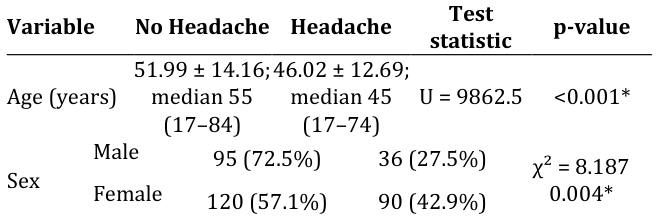
Of the 341 patients included in the study, 126 (36.9%) reported persistent headaches after COVID-19 infection. Headache was sig-nificantly more common in women than in men. Patients with head-ache were significantly younger than those without headache (Ta-ble 1). No statistically significant association was found between headache and body mass index (BMI), smoking status, or comorbid-ities. The median time from COVID-19 diagnosis to neurological evaluation did not differ significantly between patients with and
without headache (P = 0.060).
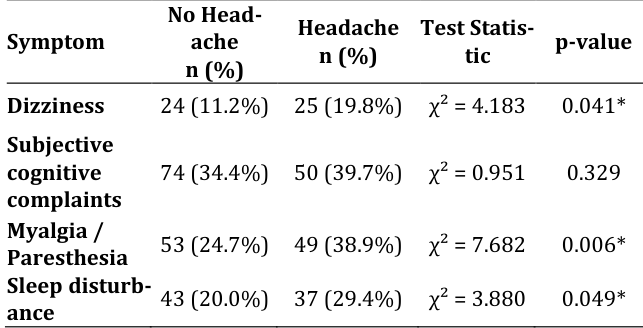
The presence of headache was significantly associated with var-ious concomitant symptoms. Individuals experiencing headaches had a higher incidence of dizziness, myalgia or paresthesia, and sleep disturbance. However, no statistically significant association was found between headache and cognitive complaints (Table 2).
Neuroimaging analysis revealed significant differences between patients with and without headache. Pathological DWI findings were more frequent in patients without headaches than in those with headaches (37.2% vs. 15.1%), whereas normal DWI findings were more common in patients with headaches (31.7% vs. 16.7%; p < 0.001). A similar distribution was observed on MR ve-nography. Pathological venous findings were significantly more fre-quent in patients without headaches than in those with headaches (62.3% vs. 19.8%), whereas normal venography results predomi-nated among patients with headaches (45.2% vs. 14.9%; p < 0.001). In contrast, the conventional brain MRI findings did not differ sig-nificantly between the two groups (p = 0.097).
Table 1
Age and Sex Distribution by Headache Status
Relationship Between Headache and Other Post-COVID Symptoms
Further exploratory analyses were conducted to evaluate the la-boratory and clinical correlates of cognitive symptoms. Patients re-porting forgetfulness exhibited significantly higher folate levels (mean: 8.04 vs. 6.33 ng/mL, p = 0.002) and higher fasting blood glu-cose levels (median: 103.5 vs. 97 mg/dL, p = 0.017) than those with-out forgetfulness. No other significant associations were found be-tween forgetfulness and hematological parameters.
Headache severity, assessed using a visual analog scale (VAS), was significantly higher in patients with a prior history of headache than in those without (median VAS score: 63 vs. 55; p < 0.001). In addition, headache severity differed according to MR venography status (p = 0.039), with higher median VAS scores observed in pa-
tients with abnormal or unavailable venography compared with those with normal findings.
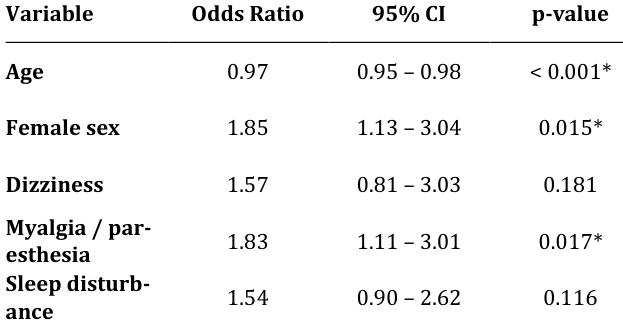
In the multivariate logistic regression analysis, younger age and female sex were independently associated with post-COVID head-ache. Specifically, while increasing age emerged as a protective fac-tor, female participants were almost twice as likely to experience headaches as male participants.
Among the accompanying symptoms, myalgia or numbness re-mained significantly associated with headache, even after adjusting for other variables. In contrast, although more common in the head-ache group in univariate analyses, dizziness and sleep disorders did not show statistical significance in the multivariate model (Table 3).
Table 3
Multivariate Logistic Regression Results for Post-COVID Headache
4. Discussion
In this study, we evaluated the clinical features, accompanying symptoms, and neuroimaging findings related to persis-tent headaches after COVID-19. Persistent headache was observed in 36.9% of patients and was particularly more common in young women; this demographic pattern is consistent with previous re-ports on post-infection and post-COVID headache syndromes 1-
3. Although headache after viral illness is not a new clinical phenom-enon, the COVID-19 pandemic has significantly expanded our un-derstanding of long-term neurological sequelae following viral in-fection 6-7. Our findings confirm the known epidemiological trends and provide new evidence of associated symptoms and imaging cor-relations.
A key observation of this study was the strong association be-tween headache and accompanying symptoms such as dizziness, myalgia/paresthesia, and sleep disturbances. These symptom clus-ters reflect previously identified dysautonomic and neuroinflamma-tory patterns in patients with long-term COVID and chronic fatigue-related disorders 8-9. Their consistent co-occurrence supports the hypothesis that post-COVID headache is part of a broader neuroim-mune or central sensitization process rather than a purely nocicep-tive or peripheral mechanism 10. These findings suggest that both demographic factors and specific neurological symptoms may con-tribute to the pathophysiology and perception of post-COVID head-ache.
Contrary to conventional assumptions, patients experienc-ing headaches had fewer abnormal findings on DWI and MR venog-raphy than those without headaches. Although conventional MR re-sults did not differ between the groups, pathologies such as diffu-sion restriction or venous abnormalities were significantly more
common in the group without headache. This was an unexpected finding, which has clinical significance and suggests that post-COVID headaches do not correspond to structural brain changes detectable by routine imaging but may reflect functional, metabolic, or connec-tivity-based changes 11-13. This interpretation is consistent with studies showing microcirculatory disturbances, autonomic imbal-ance, and altered functional connectivity with more advanced imag-ing methods in long-term COVID patients without visible lesions on routine imaging 14-15. Individuals with pre-existing headache disor-ders reported significantly higher VAS scores, indicat-ing an underlying sensitivity. Notably, the highest pain scores were observed in patients who did not undergo venogra-phy, which may indicate a subgroup whose symptoms are driven by functional rather than structural mechanisms 2, 16. Traditional sys-temic risk factors, including BMI, smoking, and comorbidities, were not statistically associated with headache, highlights that post-COVID headache is driven by neurobiological rather than systemic factors.
Cognitive complaints, frequently reported in long-term COVID, were not associated with headache in this cohort, consistent with previous studies showing that cognitive dysfunction and headache generally follow separate trajectories 16. However, the observed dif-ferences in folate and glucose levels in patients with cognitive com-plaints highlight the complexity of post-COVID cognitive symptoms and warrant further investigations. Overall, the findings of this study reinforce the idea that post-COVID headache may constitute a distinct clinical phenotype. Although the acute phase of the pan-demic is diminishing, long-term neurological complaints, including persistent headaches, continue to pose significant clinical challenge 17-19. Longitudinal cohort studies using functional imaging tech-niques and inflammatory or immunological bi-omarkers are crucial for elucidating the underlying mechanisms of persistent headaches and identifying effective treatment strategies. Clinicians should be aware that standard structural neuroimaging may not capture the underlying dysfunction in these patients, and more detailed imaging studies may be required to identify these cases.
Some methodological limitations of this study should be consid-ered. Neuroimaging examinations were performed based on clinical indications and not within a standard screening protocol. This car-ries a risk of selection bias, particularly because patients with more severe, persistent, or atypical neurological symptoms are more likely to be referred for DWI or MR venography. Therefore, the ab-sence or presence of imaging findings may not be representative of the entire post-COVID-19 headache population. Furthermore, the time between COVID-19 diagnosis and neuroimaging was not sys-tematically recorded in this retrospective dataset; therefore, the median imaging time could not be determined. The fact that imaging was performed at different time points than infection may have con-tributed to the failure to capture functional or microvascular changes, particularly those occurring late with conventional imag-ing. These limitations should be considered in the interpretation of the findings and addressed in future prospective studies with stand-ardized imaging time. Another limitation of this study is its cross-sectional design, which does not allow for causal or dynamic infer-ences about the course, persistence, or spontaneous resolution tendencies of headaches over time. Patients were evaluated at a sin-gle time point, and longitudinal headache follow-up, symptom pro-gression, and treatment response were not included in this dataset. This may limit the interpretation of the findings, particularly re-garding the natural course and phenotypic transformation of post-COVID headache. Future prospective and longitudinal studies will elucidate the evolution of headaches over time, determinants of persistence, and underlying mechanisms.
5.
Conclusions
This study contributes to the understanding of post-COVID-19 headache by identifying its characteristic demographic and clinical profiles and examining neuroimaging abnormalities. The absence of structural correlations in routine MRI, DWI, and MR venography suggests a predominantly functional or neuroimmune mechanism rather than an anatomical mechanism. By synthesizing clinical fea-tures, associated symptom clusters, and imaging data from a large real-world cohort, this study highlights critical gaps in current diag-nostic approaches and underscores the need for multidisciplinary management strategies for long-term COVID-related neurological symptoms. This information can contribute to a broader under-standing of post-COVID headache syndrome and improve the clini-cal interpretation of post-COVID headaches.
Statement of ethics This study was conducted in accordance with the principles of the Declaration of Helsinki. Ethical approval was obtained from the Eskişehir City Hospital Scientific Research Ethics Committee on 11 September 2025 (Approval No: ESH/BAEK 2025/216). The protocol titled “Persistent Post-COVID Headache: Clinical Features and Neuroimaging Findings” was reviewed and approved without any ethical or scientific objection.
Acknowledgements
None.
Funding This research received no specific grant from any funding agency in the public, commercial, or not-for-profit sectors.
Conflict of interest statement The authors declare that they have no conflict of interest.
Availability of data and materials The data and materials of this study are available upon reasonable request.
Author contributions DAM: Conceptualization, methodology, investigation, data acquisition, formal analysis, writing – original draft, writing – review and editing. GU: Data acquisition, clinical evaluation, writing – review and editing. PUU: Data acquisition, resources, writing – review and editing. ZÖA: Data acquisition, resources, writing, review and editing. All authors read and approved the final version of the manuscript.
genAI No artificial intelligence-based tools or generative AI technologies were used in this study. The entire content of the manuscript was originally prepared, reviewed, and approved by both authors.
References
- Fernández-de-las-Peñas C, Navarro-Santana M, Gómez-Mayordomo V, Cuadrado ML, García-Azorín D, Arendt-Nielsen L, et al. Headache as an acute and post-COVID-19 symptom in COVID-19 survivors: a meta-analysis of the current literature. Eur J Neurol. 2021;28(11):3820-3825. Crossref
- Sampaio Rocha-Filho PA. Headache associated with COVID-19: Epidemiology, characteristics, pathophysiology, and management. Headache. 2022;62(6):650-656. Crossref
- Caronna E, Van Den Hoek TC, Bolay H, Garcia-Azorin D, Gago-Veiga AB, Valeriani M, et al. Headache attributed to SARS-CoV-2 infection, vaccination and the impact on primary headache disorders of the COVID-19 pandemic: a comprehensive review. Cephalalgia. 2023;43(1):03331024221131337. Crossref
- Excellence C. COVID-19 rapid guideline: managing the long-term effects of COVID-19. NG188. London: National Institute for Health and Care Excellence; 2020.
- Fernández-de-las-Peñas C, Palacios-Ceña D, Gómez-Mayordomo V, Cuadrado ML, Florencio LL. Defining post-COVID symptoms (post-acute COVID, long COVID, persistent post-COVID): an integrative classification. Int J Environ Res Public Health. 2021;18(5):2621. Crossref
- Garcia-Azorin D, Layos-Romero A, Porta-Etessam J, Membrilla JA, Caronna E, Gonzalez-Martinez A, et al. Post-COVID-19 persistent headache: a multicentric 9-months follow-up study of 905 patients. Cephalalgia. 2022;42(8):804-809. Crossref
- Porta-Etessam J, Matías-Guiu JA, González-García N, Gómez Iglesias P, Santos-Bueso E, Arriola-Villalobos P, et al. Spectrum of headaches associated with SARS-CoV-2 infection: study of healthcare professionals. Headache. 2020;60(8):1697-1704. Crossref
- Széphelyi K, Kóra S, Orsi G, Tollár J. Brain Structural Abnormalities in Patients with Post-COVID-19 Headache. Neurol Int. 2025;17(4):50. Crossref
- Tanashyan MM, Kuznetsova PI, Morozova SN, Annushkin VA, Raskurazhev AA. Neuroimaging correlates of post-COVID-19 symptoms: a functional MRI approach. Diagnostics (Basel). 2024;14(19):2180. Crossref
- Lee MH, Perl DP, Steiner J, Pasternack N, Li W, Maric D, et al. Neurovascular injury with complement activation and inflammation in COVID-19. Brain. 2022;145(7):2555-2568. Crossref
- Mohammadi S, Ghaderi S. Post-COVID-19 conditions: a systematic review on advanced magnetic resonance neuroimaging findings. Neurol Sci. 2024;45(5):1815-1833. Crossref
- Mohan N, Fayyaz MA, Del Rio C, Khurana NKRS, Vaidya SS, Salazar E, et al. Neurological manifestations and neuroimaging findings in patients with SARS-CoV2-a systematic review. Egypt J Neurol Psychiatr Neurosurg. 2021;57(1):68. Crossref
- Ocak Ö, Şahin EM. Evaluation of Headache Characteristics in Patients Presenting with Suspected COVID-19. Ankara Med J. 2021;21(4):585-593. Crossref
- Liu JWTW, de Luca RDa, Mello HO, Barcellos I. Post-COVID-19 Syndrome? New daily persistent headache in the aftermath of COVID-19. Arq Neuropsiquiatr. 2020;78(11):753-754. Crossref
- Membrilla JA, Caronna E, Trigo-López J, González-Martínez A, Layos-Romero A, Pozo-Rosich P, et al. Persistent headache after COVID-19: Pathophysiology, clinic and treatment. Neurol Perspect. 2021;1(Suppl 1):S31-S36. Crossref
- Gomez-Dabo L, Melgarejo-Martinez L, Caronna E, Pozo-Rosich P. Headache in COVID-19 and long COVID: to know facts for clinical practice. Curr Neurol Neurosci Rep. 2023;23(10):551-560. Crossref
- Navis A, editor. A review of neurological symptoms in long COVID and clinical management. Semin Neurol. 2023;43(2):185-192. Crossref
- Rochmawati E, Iskandar AC, Kamilah F. Persistent symptoms among post-COVID-19 survivors: A systematic review and meta-analysis. J Clin Nurs. 2024;33(1):29-39. Crossref
- Taquet M, Sillett R, Zhu L, Mendel J, Camplisson I, Dercon Q, et al. Neurological and psychiatric risk trajectories after SARS-CoV-2 infection: an analysis of 2-year retrospective cohort studies including 1 284 437 patients. Lancet Psychiatry. 2022;9(10):815-827. Crossref
Copyright & License
This article retains the copyright and licence terms stated at its original publication. The journal's later licensing policy does not replace or amend those terms.
Read the original article PDF for the applicable copyright and reuse terms.