Abstract
Purpose: This study aims to compare two prevalent surgical techniques for cubital tunnel syndrome (CuTS): ulnar nerve in situ decompression (ISD) and subcutaneous anterior transposition (SAT), with an emphasis on clinical outcomes, surgical period, and complications.Material Methods: Sixty-nine patients who underwent surgery for CuTS between 2018 and 2023 and were followed up for a minimum of 12 months were retrospectively evaluated. Patients whose diagnosis was confirmed by electromyography and who had symptoms that persisted despite conservative treatment were included in the study. Patients were divided into two groups based on the surgical technique used: ISD (Group 1, n = 37) and SAT (Group 2, n = 32). The groups were compared in terms of demographic characteristics, preoperative Dellon classification, surgical duration, complications, and clinical outcomes at the last follow-up. Clinical evaluation was performed using the Visual Analog Scale (VAS), Quick Disabilities of the Arm, Shoulder, and Hand (QuickDASH), Modified Bishop score, and range of motion (ROM) of the elbow.Results: The mean age of the patients was 42.36±12.16 years, and the mean follow-up period was 48.36±24.47 months. No significant differences were found between the groups in terms of age, gender, affected side, dominant extremity distribution, and preoperative Dellon stages (p>0.05). The mean surgical time was significantly shorter in the ISD group compared to the SAT group (34.76±8.65 min vs. 55.41±13.25 min; p0.05 for all). Complication rates were 8.1% in the ISD group and 6.3% in the SAT group, with no significant difference between the groups.Conclusion: In cubital tunnel syndrome surgery, ISD and SAT techniques provide similar results in terms of clinical efficacy. However, ISD stands out as a practical and effective surgical option in the appropriate patient group due to its shorter surgical time and limited surgical dissection requirements. The choice of surgical technique should be individualized according to the patient's specific clinical and anatomical characteristics.Level of Evidence: Level III, Retrospective comperative study
Keywords: Cubital tunnel syndrome; ulnar nerve; in situ decompression; subcutaneous anterior transposition; peripheral nerve surgery
1. Introduction
Cubital tunnel syndrome (CuTS) is a compression pathology of the ulnar nerve and is the second most common compression neuropathy after carpal tunnel syndrome 1. Symptoms may be limited to paresthesia in the ulnar nerve dermatome area, but depending on the severity and duration of compression, muscle atrophy, permanent sensory loss, and even joint contracture may develop 2,3. In mild cases, non-surgical treatments such as physical therapy, the use of a night splint to keep the elbow in extension, and injections are beneficial 4,5. In severe cases where conservative treatment has failed, surgical treatment is indicated. This includes in situ decompression (ISD) of the ulnar nerve, and may be
Corresponding Author: Tayfun Bacaksız, tayfun_bacaksiz@hotmail.com, Received:
accompanied by medial epicondylectomy or transposition of the ulnar nerve to the anterior elbow 4,6–8. In addition, transposition can be performed subcutaneously, intramuscularly, or submuscularly 1.
Although there appears to be a consensus in the literature regarding conservative treatment steps, this is not yet valid for surgical treatment options. Some reports indicate that ISD is as effective as transposition and has a similar success rate and lower complication rate 6,9. It achieves this by minimizing nerve scarring and devascularization 10. However, it may also result in further complications, such as inadequate decompression, instability caused by excessive decompression, and potentially permanent
30.12.2025, Accepted: 22.02.2026, Available Online Date: 15.03.2026.
No Derivatives License 4.0 (CC-BY-NC-ND), where it is permissible to download and share the work provided it is properly cited. The work cannot be changed in any way or used commercially without permission from the journal.
symptoms 7,8,11. Subcutaneous anterior transposition (SAT) of the ulnar nerve reduces tension on the ulnar nerve during flexion, preserving nerve vascularity and function, and thus has a high success rate 12–14. However, complications may occur during follow-up, and eventually, correction of the anterior compression with ISD may be required 4,15. In this context, a review of the entire literature reveals that research into the most effective technique for CuTS treatment remains required.
This study aims to compare in situ decompression and subcutaneous anterior transposition techniques in cubital tunnel syndrome surgery in terms of their effects on clinical outcomes, possible complications, and the need for repeated surgery.
2. Materials and Methods
Patients diagnosed with CuTS and operated on by the same team at the same center between 2018 and 2023 were retrospectively reviewed. Data were obtained from patient files and the hospital radiology archive after ethical committee approval (date: 11.12.2025 – decision no: 0749).
Patients with complete medical records, whose diagnosis was confirmed by electromyography (EMG), and who were treated with either ulnar nerve in situ decompression or anterior subcutaneous transposition techniques following unsuccessful conservative treatment were included in the study. Patients were divided into two groups based on the two different techniques preferred by the two upper extremity specialists in the same team, according to their experience. Exclusion criteria included the combination of CuTS treatment with other procedures such as fracture fixation or carpal tunnel release; decompression using endoscopic techniques;
Figure 1
Flowchart of the study
submuscular or subfascial anterior transposition; cubitus valgus deformity; degenerative arthritis in the elbow joint; previous elbow trauma/instability; severe cervical disc problems; inability to regularly record data; or follow-up for less than 12 months.
Evaluation Criteria Patient Data The patient’s age, gender, EMG severity, symptom duration and affected side were documented. All patients were evaluated for additional systemic diseases (diabetes, heart disease, thyroid or kidney disorders). Patients were categorized according to the severity of their symptoms using the Dellon classification before surgery.
Outcomes Data Surgical time was taken into account as surgical data. Complications were recorded. Clinical data included elbow range of motion (ROM), Quick Disabilities of the Arm, Shoulder, and Hand (QuickDASH), Visual Analogue Scale (VAS) for pain scores, and the Modified Bishop rating system for postoperative satisfaction and function assessment. Clinical measurements were performed by the senior author according to standard protocols. Data were obtained at the final follow-up examination.
Statistical Analysis Data analysis was performed using SPSS 22 (Released 2013, NY: IBM Corp.) software. Normality of distribution was assessed using the Shapiro-Wilk test. Descriptive statistics were presented as number (n), percentage (%), mean, and standard deviation (±). The Pearson Chi-square test was used to compare categorical data of groups. For comparison of numerical values, the independent t-test (Student t-test) was used if a normal distribution was present, and the Mann-Whitney U test was used if a normal distribution was not present. A significance level of p<0.05 was accepted for all analyses.
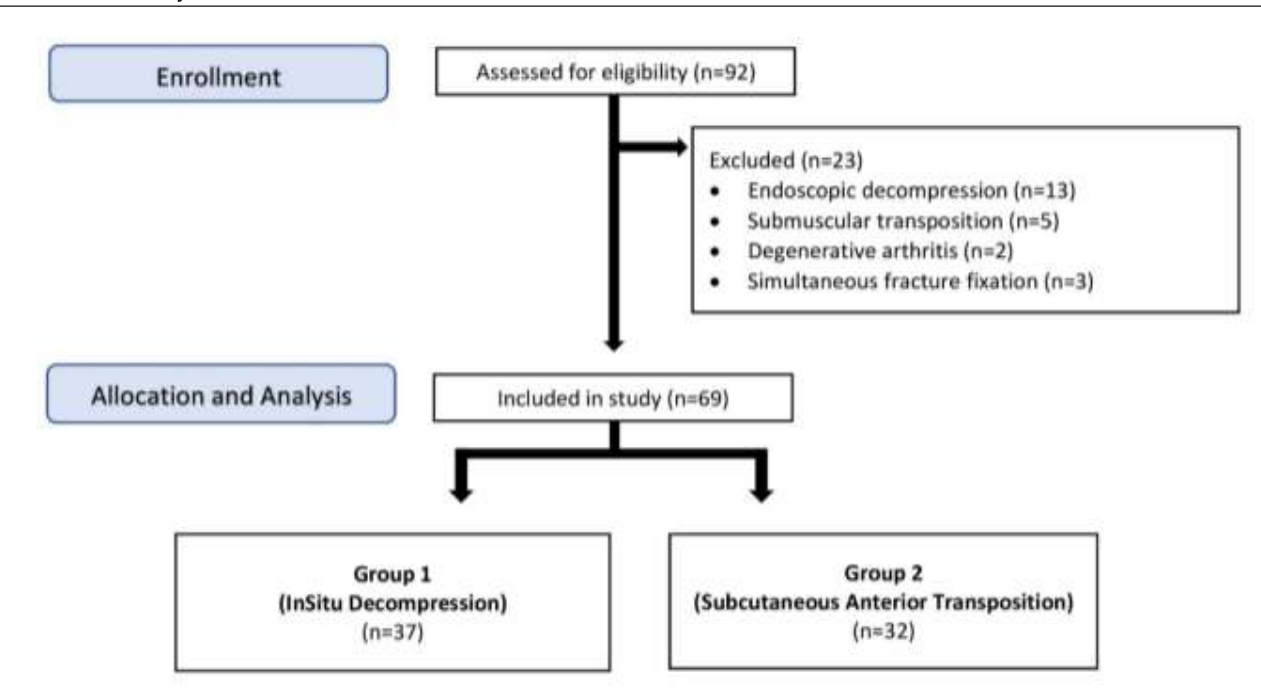
Table 1
Clinical data of all patients and comparison between groups In Situ Decompression (Group 1) and Subcutaneous Anterior Transposition (Group 2)
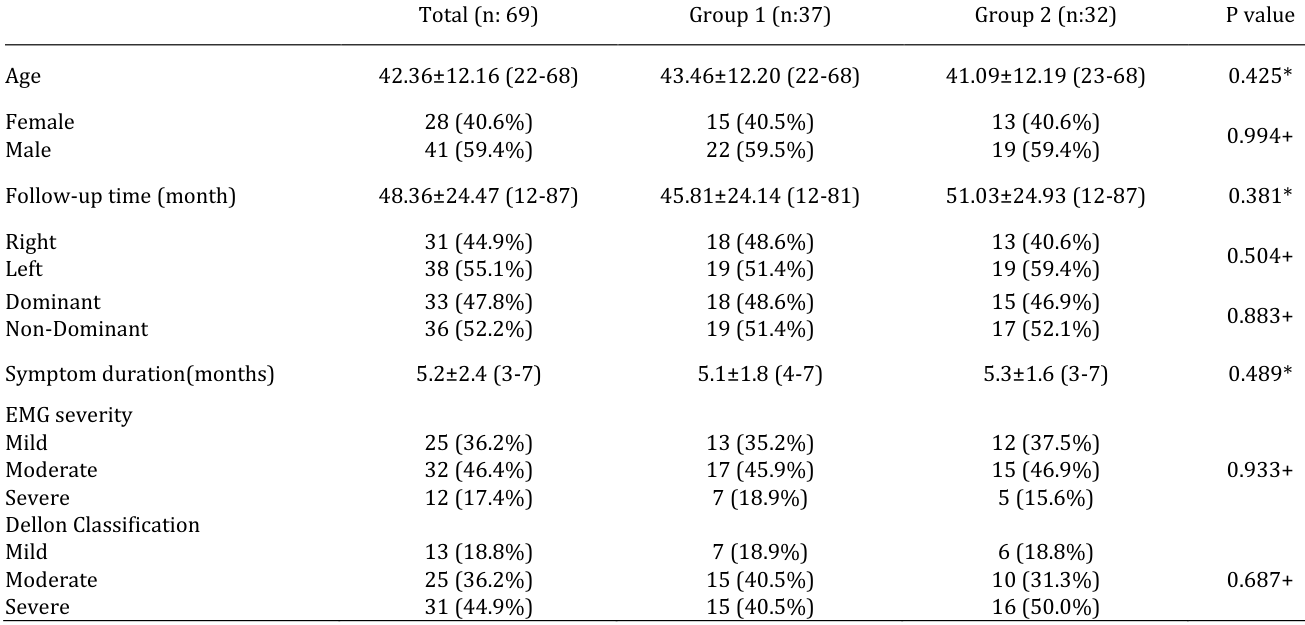
*: Student t-test; +: Pearson Chi-square test, EMG: Electromyography
Table 2
Clinical outcomes at the last follow-up
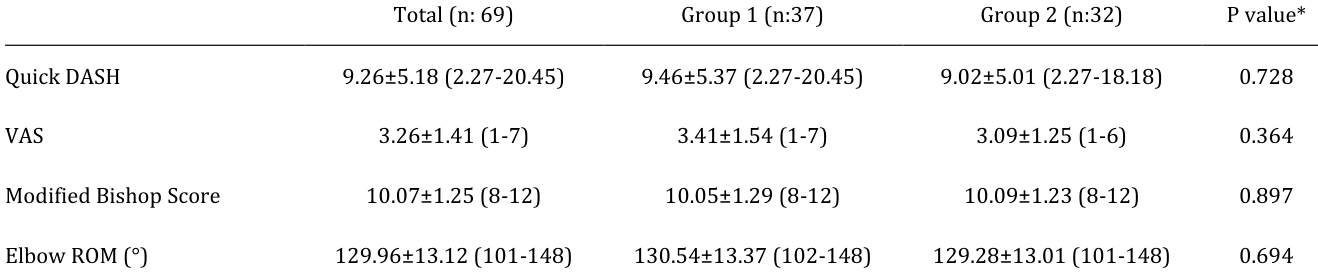
DASH: Quick Disabilities of the Arm, Shoulder, and Hand; VAS: Visual Analogue Scale; ROM: Range of Motion; *: Student t-test
3. Results
The study population consisted of 69 patients who met the inclusion criteria. The mean age of the patients was 42.36±12.16 (range 22-68), and 41 (59.4%) were male, and 28 (40.6%) were female. The affected side was the right upper extremity in 31 (44.9%) patients and the left upper extremity in 38 (55.1%) patients. The affected extremity was the dominant side in 33 (47.8%) patients and the non-dominant side in 36 (52.2%) patients. In terms of surgical technique, 37 (53.6%) patients who underwent ISD formed Group 1, while 32 (46.4%) patients who underwent SAT formed Group 2 (Figure 1). The age and gender distributions, affected side, EMG severity, symptom duration and preoperative Dellon classification stages according to groups are presented in Table 1. Additionally, there were no significant differences between
the groups in terms of diabetes mellitus and other comorbidities (p > 0.05).
The mean operation time was 44.33±15.08 (23-84) minutes. When the relationship between the groups was examined, the operation time of Group 1 [34.76±8.65 (23-51) min] was statistically significantly lower than Group 2 [55.41±13.25 (36-84) min] (p<0.001).
The clinical data obtained from the last follow-up in the postoperative controls and the comparisons of these data between the groups are given in detail in Table 2.
Complications were encountered in a total of 5 (7.2%) patients, 3 (subluxation:2, insufficient relaxation:1) in Group 1 and 2 (recurrent nerve compression at transferred site:2). in Group 2. No significant relationship was found between the groups in terms of the occurrence of complications (p=0.767). In Group 1, two patients
developed symptoms during follow-up due to the occurrence of ulnar nerve subluxation after surgery, while another patient persisted with symptoms of cubital tunnel syndrome due to insufficient relaxation. In Group 2, two patients developed symptoms of recurrent nerve compression and Tinel positivity in the area where they were transferred. No patient underwent repeat surgery after complications.
4. Discussion
This study has demonstrated that the two most commonly used techniques in cubital tunnel syndrome surgery, ISD and SAT, provide similar clinical outcomes in terms of pain reduction, functional improvement, and patient satisfaction. However, there is a significant advantage in favor of ISD in terms of surgical time. These findings are consistent with the general trends reported in the current literature 16–18.
The pathophysiology of CuTS is explained through three main mechanisms: static compression, dynamic tension, and microvascular perfusion impairment 19,20. Although ISD and SAT techniques target these mechanisms in different ways, static compression has been reported to be the primary determinant of symptoms, particularly in mild to moderate cases of CuTS 19,21. In this context, decompressing the nerve while preserving its anatomical structure may be sufficient for clinical improvement in most patients. Although the SAT technique theoretically aims to reduce tension on the nerve during flexion, many studies have shown that the benefits of this technique are limited in terms of clinical outcomes 16,17,22. The similar functional scores in both groups in our study indicate that dynamic tension reduction is not mandatory for every patient in the treatment of CuTS.
In our study, the significantly shorter surgical duration in the ISD group is an advantage frequently emphasized in the literature 17,23. Shorter surgical duration is associated with less soft tissue dissection, lower bleeding risk, and less postoperative fibrosis. Limited surgical trauma may positively contribute to nerve healing, particularly in individuals with systemic diseases that increase the risk of neuropathy, such as diabetes 21,24.
The types of complications reported for both techniques are similar to those in the literature. Ulnar nerve subluxation observed after ISD and persistent symptoms due to inadequate release may occur, especially in cases where nerve stability was not adequately assessed in the preoperative period 19,22. Recurrence of compression symptoms in the SAT group is associated with scar tissue formation in the new nerve bed or inadequate anteriorization 25. Preservation of nerve vascularity is one of the most important determinants of functional recovery after surgery. Leaving the nerve in its natural position in the ISD technique allows preservation of the epineural vascular supply, whereas nerve mobilization and placement in a new position during SAT may increase the risk of devascularization and perineural scar formation 25. This may explain the reports of recurrent compression in the anterior region or late-stage symptom recurrence after SAT in some studies 23,26. The recurrent compression symptoms observed in the SAT group in our study are also consistent with this biological mechanism.
Revision surgery was not required in any patient in our study, which is remarkable. This situation demonstrates that both approaches have a high safety profile when appropriate patient selection and surgical technique are correctly applied. However, some long-term studies have reported that revision rates after ISD may be higher, and it is emphasized that this risk is particularly increased in cases with ulnar nerve instability 26.
The obtained outcomes indicate that there is no single ideal approach in the choice of surgical technique; rather, a patient-based assessment is necessary. While the SAT may be a more appropriate option in patients with ulnar nerve instability, previous elbow trauma, cubitus valgus deformity, or significant nerve tension findings, ISD may be preferred in cases without these characteristics due to its shorter surgical duration and similar clinical success 18,23. The significantly shorter surgical time observed in the ISD group is not only an operational advantage but also reflects the minimal effective surgery approach 18. Shorter surgical time is associated with less soft tissue damage, lower postoperative inflammation, and potentially faster rehabilitation. Minimizing surgical stress on the nerve may have a positive effect on clinical outcomes, especially in patients at risk for diabetes, thyroid disease, or peripheral neuropathy 21,24. Therefore, ISD can be considered not only practical but also a more biological approach in the appropriate patient group.
While some studies in the literature suggest that anterior transposition provides superior outcomes in severe CuTS cases 27,28, the vast majority of meta-analyses do not confirm this superiority 16–18. This discrepancy is primarily due to the heterogeneity of patient populations, differences in staging systems, and variability in surgical technique details. In our study, the similarity of preoperative Dellon stages between groups reduced the effect of such confounding factors and enabled a more reliable comparison.
Our study has some limitations. The retrospective design, the lack of randomized surgical techniques, and the unblinded nature of the clinical assessment are potential sources of bias. Furthermore, the absence of postoperative electrophysiological evaluations limited the assessment of the neurophysiological correlation between clinical improvement and surgical accuracy. However, the fact that all surgeries were performed at the same center and by the same team can be considered a significant strength, minimizing variations in technical application and enhancing the internal validity of the study. Although the inability to analyse early-stage data may be considered another limitation, we believe that the results of mid- and long-term follow-ups will provide a more objective assessment of the effects on patients’ clinical scores and quality of life.
5. Conclusion
This study demonstrates that ISD and SAT techniques provide similar clinical efficacy outcomes in cubital tunnel syndrome surgery, but ISD provides a practical advantage with its shorter surgical time. In patients without significant ulnar nerve instability or elbow deformity, ISD can be an effective and practical surgical option. Subcutaneous anterior transposition (SAT) remains a valid alternative when appropriate patient selection is made. Based on patient-specific clinical and anatomical factors and the surgeon’s experience, personalizing the surgical technique would be the most rational approach.
Statement of ethics The study was approved by the Izmir Katip Celebi University Ethics Committee (date: 11.12.2025 – decision no: 0749), was conducted in accordance with the Declaration of Helsinki.
genAI No artificial intelligence-based tools or generative AI technologies were used in this study. The entire content of the manuscript was originally prepared, reviewed, and approved by both authors.
Funding This research received no specific grant from any funding agency in the public, commercial, or not-for-profit sectors.
Conflict of interest statement The authors declare that they have no conflict of interest.
Availability of data and materials The datasets used and/or analyzed during the current study are available from the corresponding author upon reasonable request.
Author contributions Both authors contributed equally to the conception, writing, and revision of the manuscript. Both authors read and approved the final version of the manuscript.
References
- Boone S, Gelberman RH, Calfee RP. The Management of Cubital Tunnel Syndrome. J Hand Surg Am. 2015;40(9):1897-1904. Crossref
- Mallette P, Zhao M, Zurakowski D, Ring D. Muscle Atrophy at Diagnosis of Carpal and Cubital Tunnel Syndrome. J Hand Surg Am. 2007;32(6):855-858. Crossref
- Drake ML, Hensley DT, Chen WC, Taylor KF. Muscle Atrophy at Presentation of Cubital Tunnel Syndrome: Demographics and Duration of Symptoms. Hand (N Y). 2017;12(1):64-67. Crossref
- Graf A, Ahmed AS, Roundy R, Gottschalk MB, Dempsey A. Modern Treatment of Cubital Tunnel Syndrome: Evidence and Controversy. J Hand Surg Glob Online. 2023;5(4):547-560. Crossref
- Shah CM, Calfee RP, Gelberman RH, Goldfarb CA. Outcomes of rigid night splinting and activity modification in the treatment of cubital tunnel syndrome. J Hand Surg Am. 2013;38(6):1125-1130.e1. Crossref
- Kessler RB, Thompson RG, Lourie GM. Cubital tunnel syndrome: a surgical modification to in situ decompression to improve results. JSES Int. 2020;4(1):15-20. Crossref
- Gaspar MP, Kane PM, Putthiwara D, Jacoby SM, Osterman AL. Predicting Revision Following in Situ Ulnar Nerve Decompression for Patients with Idiopathic Cubital Tunnel Syndrome. J Hand Surg Am. 2016;41(3):427-435. Crossref
- Zhang D, Earp BE, Blazar P. Rates of Complications and Secondary Surgeries After In Situ Cubital Tunnel Release Compared With Ulnar Nerve Transposition: A Retrospective Review. J Hand Surg Am. 2017;42(4):294.e1-294.e5. Crossref
- Sousa M, Aido R, Trigueiros M, Lemos R, Silva C. Cubital compressive neuropathy in the elbow: in situ neurolysis versus anterior transposition -comparative study. Rev Bras Ortop (Engl Ed). 2014;49(6):647-652. Crossref
- Nakamura K, Uchiyama S, Ido Y, Itsubo T, Hayashi M, Murakami H, et al. The effect of vascular pedicle preservation on blood flow and clinical outcome following ulnar nerve transposition. J Hand Surg Am. 2014;39(2):291-302. Crossref
- Dellon AL, Chang E, Coert JH, Campbell KR. Intraneural ulnar nerve pressure changes related to operative techniques for cubital tunnel decompression. J Hand Surg Am. 1994;19(6):923-930. Crossref
- Foran I, Vaz K, Sikora-Klak J, Ward SR, Hentzen ER, Shah SB. Regional Ulnar Nerve Strain Following Decompression and Anterior Subcutaneous Transposition in Patients With Cubital Tunnel Syndrome. J Hand Surg Am. 2016;41(10):e343-e350. Crossref
- Lundborg G, Rydevik B. Effects of stretching the tibial nerve of the rabbit. A preliminary study of the intraneural circulation and the barrier function of the perineurium. J Bone Joint Surg Br. 1973;55(2):390-401. Crossref
- Mitchell J, Dunn JC, Kusnezov N, Bader J, Ipsen DF, Forthman CL, et al. The effect of operative technique on ulnar nerve strain following surgery for cubital tunnel syndrome. Hand (N Y). 2015;10(4):707-711. Crossref
- Eberlin KR, Marjoua Y, Jupiter JB. Compressive Neuropathy of the Ulnar Nerve: A Perspective on History and Current Controversies. J Hand Surg Am. 2017;42(6):464-469. Crossref
- Zlowodzki M, Chan S, Bhandari M, Kalliainen L, Schubert W. Anterior transposition compared with simple decompression for treatment of cubital tunnel syndrome: A meta-analysis of randomized, controlled trials. J Bone Joint Surg Am. 2007;89(12):2591-2598. Crossref
- Said J, Van Nest D, Foltz C, Ilyas AM. Ulnar Nerve In Situ Decompression versus Transposition for Idiopathic Cubital Tunnel Syndrome: An Updated Meta-Analysis. J Hand Microsurg. 2019;11(1):18-27. Crossref
- Macadam SA, Gandhi R, Bezuhly M, Lefaivre KA. Simple Decompression Versus Anterior Subcutaneous and Submuscular Transposition of the Ulnar Nerve for Cubital Tunnel Syndrome: A Meta-Analysis. J Hand Surg Am. 2008;33(8):1314.e1-1314.e12. Crossref
- Dellon AL. Review of treatment results for ulnar nerve entrapment at the elbow. J Hand Surg Am. 1989;14(4):688-700. Crossref
- Bartels RHMA, Menovsky T, Van Overbeeke JJ, Verhagen WIM. Surgical management of ulnar nerve compression at the elbow: An analysis of the literature. J Neurosurg. 1998;89(5):722-727. Crossref
- Bartels RHMA, Verhagen WIM, Van Der Wilt GJ, Meulstee J, Van Rossum LGM, Grotenhuis JA. Prospective randomized controlled study comparing simple decompression versus anterior subcutaneous transposition for idiopathic neuropathy of the ulnar nerve at the elbow: Part 1. Neurosurgery. 2005;56(3):522-529. Crossref
- Biggs M, Curtis JA. Randomized, prospective study comparing ulnar neurolysis in situ with submuscular transposition. Neurosurgery. 2006;58(2):296-303. Crossref
- Abouzeid W, Almamoun M, Niazy T, Abbas M, Abdeltawab M. Ulnar Nerve in Situ Decompression versus Transposition for Idiopathic Cubital Tunnel Syndrome: Long-term clinical outcome: Multicenteric retrospective study. Pan Arab J Neurosurg. 2022;17(1):71-79. Crossref
- Caliandro P, La Torre G, Padua R, Giannini F, Padua L. Treatment for ulnar neuropathy at the elbow. Cochrane Database Syst Rev. 2016;2016(11):CD006839. Crossref
- Mowlavi A, Andrews K, Lille S, Verhulst S, Zook EG, Milner S. The management of cubital tunnel syndrome: A meta-analysis of clinical studies. Plast Reconstr Surg. 2000;106(2):327-334. Crossref
- Hutchinson DT, Sullivan R, Sinclair MK. Long-term Reoperation Rate for Cubital Tunnel Syndrome: Subcutaneous Transposition Versus In Situ Decompression. Hand (N Y). 2021;16(4):447-452. Crossref
- Carlton A, Khalid SI. Surgical Approaches and Their Outcomes in the Treatment of Cubital Tunnel Syndrome. Front Surg. 2018;5:48. Crossref
- Gervasio O, Gambardella G. Anterior submuscular transposition of the ulnar nerve in severe cubital tunnel syndrome: Personal experience. J Neurosurg Sci. 2004;48(3):113-116.
Copyright & License
This article retains the copyright and licence terms stated at its original publication. The journal's later licensing policy does not replace or amend those terms.
Read the original article PDF for the applicable copyright and reuse terms.