Abstract
Objective: Osteoporosis (OP) is highly prevalent among patients with inflammatory rheumatic and musculoskeletal diseases (iRMDs), yet it remains frequently underdiagnosed and undertreated in this population. This study aimed to evaluate the levels of osteoporosis knowledge and awareness among patients diagnosed with iRMDs.Methods: A total of 120 patients with iRMDs (56 males, 64 females; mean age: 41 ± 11.9 years) were included in this cross-sectional study. Demographic data, disease diagnosis, and disease duration were recorded. Participants were surveyed regarding general aspects of osteoporosis, nutrition, and exercise. OP knowledge was assessed using the Revised Osteoporosis Knowledge Test (OKT), and awareness was evaluated via the Osteoporosis Awareness Scale (OAS).Results: Of the patients included in the study, 79 (65.8%) knew they were at high risk for osteoporosis. Both OP awareness (73.6 ± 18.7) and knowledge scores (15.4 ± 4.97) were found to be suboptimal among iRMD patients. A strong positive correlation was identified between educational attainment and both OKT and OAS scores. Participants receiving corticosteroid therapy exhibited significantly higher levels of OP awareness. Furthermore, a positive association was observed between physical activity levels and OAS scores.Conclusion: The results of this study indicated that although the vast majority of patients with iRMDs perceive themselves to be in a high-risk group for OP, their level of knowledge regarding OP is low and their awareness level is insufficient. To reduce the incidence of osteoporosis and its associated morbidity and mortality, patient education programs should be organized specifically for patients with iRMDs.
Keywords: Awareness; knowledge; osteoporosis; inflammatory rheumatic diseases.
1. Introduction
A decrease in bone mineral density and degeneration of the microarchitecture of bone tissue are the hallmarks of osteoporosis, a systemic metabolic bone disease that increases the risk of fragility fractures.1 Osteoporosis and fractures are more common in patients with inflammatory rheumatic and musculoskeletal diseases (iRMDs), including rheumatoid arthritis, spondyloarthropathies, and connective tissue diseases.2 Bone tissue is a dynamic structure that is always changing, but persistent inflammation can upset this balance and cause bone loss to accelerate.3,4
When it comes to osteoporosis in iRMDs, current research and therapeutic recommendations usually highlight glucocorticoid use as the main risk factor, commonly ignoring both general and disease-specific osteoporosis risk factors. However, osteoporosis in iRMDs has a complex etiopathogenesis. It includes general risk factors like aging and hormonal loss during menopause, İRMDs-specific risk factors like decreased mobility, and the detrimental consequences of local and systemic inflammation caused by disease activity.5,6 Additionally, there are notable variations among individuals with iRMDs in characteristics that may lower the risk of
fracture, such as physical activity, a diet high in calcium, vitamin D levels, and the best possible control of inflammation.7 It has been demonstrated that systemic bone loss and structural bone damage can be decreased by effectively controlling inflammation in rheumatic disorders.3,4
Osteoporosis awareness is crucial for individuals with inflammatory rheumatic disorders involving joint involvement since their risk of osteoporotic fractures is significantly higher than that of the general population.2 Reducing unfavorable outcomes, such as fractures and physical handicap, requires improving osteoporosis awareness and patient education in rheumatic disorders. There is a dearth of research examining osteoporosis knowledge and awareness levels throughout the wider spectrum of iRMDs, despite studies in the literature assessing these levels in a variety of populations, particularly in individuals with rheumatoid arthritis.
The purpose of this study is to find out how much information and awareness individuals with inflammatory rheumatic and musculoskeletal disorders have about osteoporosis.
Corresponding Author: Sıdıka Büyükvural Şen, sbuyukvuralsen@gmail.com, Received: 04.01.2026, Accepted: 17.02.2026, Available Online Date: 15.03.2026.
No Derivatives License 4.0 (CC-BY-NC-ND), where it is permissible to download and share the work provided it is properly cited. The work cannot be changed in any way or used commercially without permission from the journal.
2. Materials and Methods
This cross-sectional study was carried out at a tertiary-level rheumatology outpatient clinic between September 2024 and March 2025. The purpose of the study was to assess the knowledge and awareness of osteoporosis (OP) among patients with inflammatory rheumatic and musculoskeletal diseases (iRMDs), particularly connective tissue disorders, rheumatoid arthritis (RA), and ankylosing spondylitis (AS).
The local Ethics Committee approved the study protocol (Decision No: 3186, Date: February 15, 2024). Every procedure was carried out strictly in compliance with the Declaration of Helsinki’s ethical guidelines. Every subject gave written informed consent before enrolling.
Although there was no a priori estimation of power, a post-hoc power estimation method was used. It was observed that for a total sample population of 120 subjects, this investigation had greater than 80% statistical power (1 – β > 0.80) for detecting a moderate correlation (r = 0.25 up to 0.30), α = 0.05, 2-sided. It is noteworthy that considering a moderate strength of association, as revealed by the obtained correlation coefficients between key variables, like educational level and Osteoporosis Knowledge Test (OKT)/ Osteoporosis Awareness Scale (OAS), varying from 0.21 up to 0.31, this sample had sufficient statistical power.
In this single-centre study, sequential sampling technique was used to identify participants. A total of 135 individuals who were 18 years of age or older and who’s original İRMDs diagnosis put them at high risk for secondary OP were screened for eligibility. Thirteen of these patients refused to take part, and two were disqualified because they were illiterate, making it impossible for them to finish the scales. As a result, 120 patients—64 females and 56 males— were included in the final study.
Sociodemographic information, including age, gender, body mass index (BMI), occupation, and educational attainment, as well as the rheumatological disease’s diagnosis and duration, were reported in the first section of the survey form. Alcohol consumption was classified as 0 days/week, 1-3 days/week, and ≥4 days/week, whereas coffee consumption was classified as 0 cups per day, 1-3 cups per day, and ≥4 cups per day.
Table 1
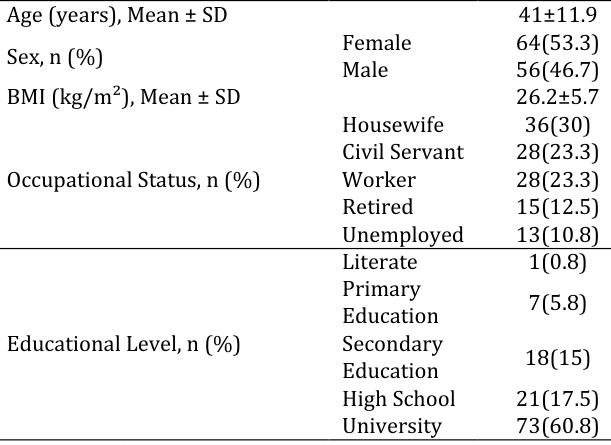
Demographic characteristics of the study participants
Note: SD: Standard Deviation; BMI: Body Mass Index.
Table 2
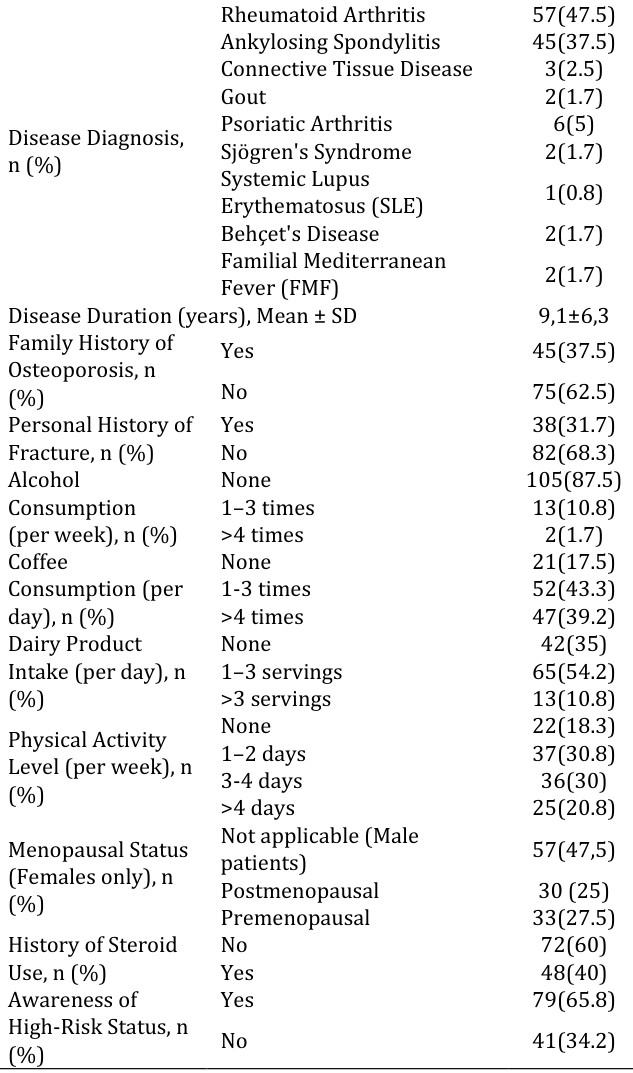
Clinical and Lifestyle Characteristics of the Patient
Note: SD: Standard Deviation
The consumption of milk and dairy products was divided into three categories: 0 servings per day, 1-3 servings per day, and ≥4 servings per day. The degree of physical activity was divided into four categories: none, 1-2 days per week, 3-4 days per week, and >4 days per week. In this section of the questionnaire, participants were also asked the following questions: “Are you aware that you belong to an osteoporosis high-risk group?” “Where do you find information about osteoporosis?” “Have you ever had a fracture?” “Is there a family history of osteoporosis?” These kinds of generic inquiries concerning osteoporosis were posed.
The updated Osteoporosis Knowledge Test (OKT) questionnaire is used in the survey’s second section to gauge respondents’ levels of osteoporosis knowledge.8 Atalay et al. established the OKT’s validity and reliability in Turkish.9 The 32 items in the questionnaire gauge respondents’ levels of osteoporosis knowledge. The first eleven questions look at osteoporosis risk factors. The options “High likelihood of osteoporosis,” “No association with osteoporosis development,” “Low likelihood of osteoporosis,” and “I don’t know” are marked in response. The answers “I don’t know” and “No
association with osteoporosis development” are deemed inaccurate and are worth zero points. Each of the two right responses, “High likelihood of osteoporosis” and “Low likelihood of osteoporosis,” is awarded one point. One point is awarded for choosing the right response from the four possibilities for the remaining questions.
There are two subscales in the OKT: There are 26 questions on the nutrition subscale, and the score ranges from 0 to 21. The 20 questions on the exercise subscale have a scoring range of 0 to 16. The total score, which goes from 0 to 32, includes 14 questions that are shared by both subscales. A higher score denotes a greater degree of osteoporosis knowledge.
The “Osteoporosis Awareness Scale” (OAS), which gauges the degree of awareness and knowledge about OP and has been demonstrated to have Turkish validity and reliability, was given to the patients in the third section of the survey.10 The 31 items on the OAS are answered on a 4-point Likert scale. “I know very well” (4), “I know” (3), “I know a little” (2), and “I don’t know at all” (1) are the scores. Awareness of OP increases along with the scale’s total score (minimum = 31, maximum = 124). Bone loss was characterized as OP in the scale.
Statistical Analysis IBM SPSS Statistics for Windows, Version 22.0 (IBM Corp., Armonk, NY, USA) was used to conduct statistical analysis. The Shapiro-Wilk test was used to determine whether the data was normal. Frequencies (n), percentages (%), means, standard deviations, and medians are examples of descriptive statistics. The correlations between category variables were investigated using the Chi-square test. When necessary, Pearson or Spearman correlation coefficients were used to examine correlations between scale scores and covariates, such as age, sex, education level, diagnosis, disease duration, steroid use, fracture history, and menopausal status. Statistical significance was defined as a p-value of less than 0.05.
Table 3
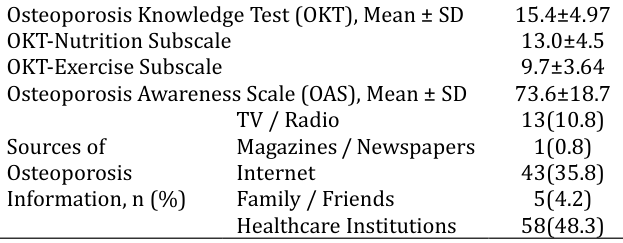
OKT and OAS Scores and Information Sources of İRMD Patients
Note: OKT: Osteoporosis Knowledge Test; OAS: Osteoporosis Awareness Scale; SD: Standard Deviation.
3. Results
A total of 120 patients diagnosed with inflammatory rheumatic and musculoskeletal diseases (İRMDs) were enrolled, comprising 56 males (46.7%) and 64 females (53.3%). The median age of the cohort was 41 ± 11.9 years. The comprehensive sociodemographic and clinical characteristics of the participants are summarized in Tables 1 and 2.
Regarding self-perceived risk, 65.8% (n=79) of the participants were aware that they belonged to a high-risk group for developing osteoporosis (OP), whereas 34.2% (n=41) were unaware of their elevated risk.
The mean Osteoporosis Awareness Scale (OAS) score for the
entire cohort was 73.6 ± 18.7. Evaluation of the Osteoporosis Knowledge Test (OKT) revealed a mean total score of 15.4 ± 4.97. Subgroup analysis of the OKT showed mean scores of 9.7 ± 3.64 for the Exercise Knowledge Test (EKT) and 13 ± 4.5 for the Nutrition Knowledge Test (NKT) (Table 3).
The primary sources of information regarding osteoporosis reported by patients were healthcare providers (48.3%) and the internet (35.8%), followed by television (10.8%), family/friends (4.2%), and newspapers/magazines (0.8%) (Table 3).
Table 4
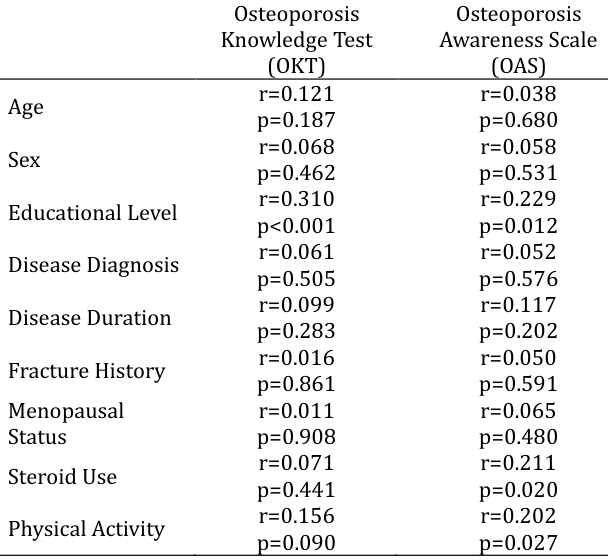
Correlation between Clinical/Demographic Variables and Scale Scores in Patients with İRMDs
Note: r = Pearson/Spearman correlation coefficient. Significant correlations (p < 0.05) are indicated in bold.
Correlation analyses involving the OKT and OAS scores are detailed in Table 4. A strong positive correlation was identified between educational attainment and both OP knowledge (OKT) and awareness (OAS) levels (r = 0.310, p < 0.001 and r = 0.229, p = 0.012, respectively).
Furthermore, a statistically significant positive correlation was observed between a history of corticosteroid use and OAS scores (r = 0.211, p = 0.020). Similarly, higher levels of physical activity were significantly associated with increased osteoporosis awareness scores (r = 0.202, p = 0.027).
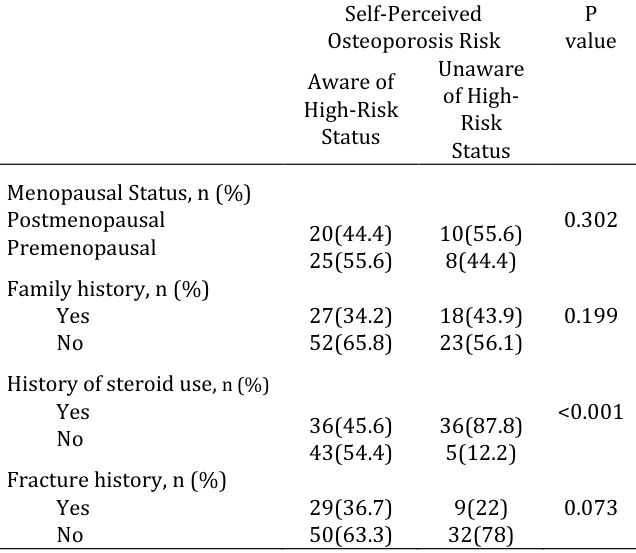
Comparative analysis revealed that patients with a history of steroid use were significantly more likely to perceive themselves as being at high risk for OP compared to non-users (p < 0.001). Among patients who perceived themselves as being at risk, 36.7% had a history of fractures, while 63.3% did not, although this association did not reach statistical significance (p = 0.073) (Table 5).
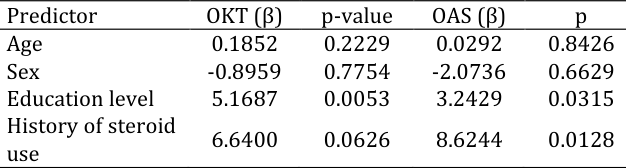
Multiple linear regression analyses of the data were carried out to investigate the independent determinants of knowledge and awareness of osteoporosis (OKT and OAS). Four factors entered the analysis: age, sex, education level, and history of steroid use. For the OKT score, education level was the only significant predictor (p = 0.0053), revealing a relation between level of education and knowledge. For the OAS score, the results indicated that the more educated the patient, the more aware he or she is of the risks of
developing osteoporosis, which was a significant factor in the model, with a p value of 0.0315. In addition, while age and gender were not found to be significant predictors of OAS in the results, the history of steroid use in the patient was identified as a significant predictor (Table 6).
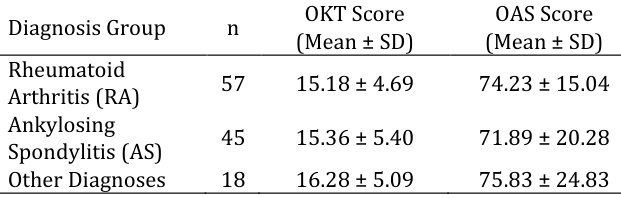
Osteoporosis knowledge and awareness subgroup analysis was done to compare knowledge and awareness in patients with rheumatoid arthritis, ankylosing spondylitis, and other inflammatory rheumatic diseases. Even small differences were noted, the result showed that there was no statistically significant difference in OKT, OAS, or knowledge awareness between rheumatic diseases, including RA, AS, others, as determined by performing the analysis of variance, where value equals 0.7172, value equals 0.7082. The result shows that rheumatic disease type did not affect the level of knowledge awareness among patients (Table 7).
Table 5
Comparison of Clinical Factors According to Patients’ Self-Perceived Osteoporosis Risk
Note: Data are presented as number and percentage n (%). Significant p-values are highlighted in bold.
Table 6
Results of Multiple Linear Regression Analyses for Predictors of OKT and OAS Scores
Note: Dependent variables: OKT = Osteoporosis Knowledge Test score; OAS = Osteoporosis Awareness Scale score. Bold values indicate statistically significant predictors (p < 0.05).
Table 7
Comparison of Osteoporosis Knowledge (OKT) and Awareness (OAS) Scores by Disease Group
Note: One-way ANOVA showed no statistically significant differences among the groups for OKT (p = 0.7172) or OAS (p = 0.7082).
4.
Discussion
Osteoporosis is a common comorbidity of inflammatory rheumatic and musculoskeletal diseases (İRMDs), increasing the risk of fractures substantially above that in the general population.2 In our current research, whereas 65.8% of patients with İRMDs were aware of their personal risk of OP, a paradox was observed, as on one side, personal risk perceptions were relatively high, and on the other side, knowledge level and awareness were low and poor, respectively.
The findings related to OP risk awareness are consistent with several studies reported in the literature but are not consistent due to variations in the findings. For example, within two studies on patients with Rheumatoid Arthritis, patients showed poor levels of risk awareness with little understanding among the majority.11,12 In another study, Gemalmaz et al.13 showed an aware level of 60.8% among Turkish women, whereas Kurt et al. showed 47.5% in their study conducted on women in the rural population who are at risk but unaware of their vulnerability.14 The slightly higher level of awareness among patients in this study can be explained by regular follow-up practices within the rheumatology clinic. The observed deficiency in detailed knowledge regarding OP suggests a gap in clinical communication. This highlights the necessity for clinicians to provide frequent and structured information. Consistent with existing literature12,14-16, a strong positive correlation was found between educational level and both OKT and OAS scores.
An important finding of our study was the fact that patients under corticosteroid treatment had a significantly higher awareness score along with a higher perceived risk of osteoporosis.17 It indicates that the warnings given by the clinicians about the risk of bone side effects of steroids produce a ‘reflex of awareness’ among the patients. Since glucocorticoid-induced osteoporosis (GIOP) is a significant preventable cause of fractures among İRMDs, the increased awareness is highly promising regarding treatment compliance.7,18
It is important to note that no significant association was detected between the duration of disease or specific İRMDs diagnosis with OP knowledge/awareness levels. This finding implies that long-term follow-up alone does not ensure adequate education of patients. Improvement in knowledge among this group is crucial, as this reflects directly on the prevention of adverse outcomes such as physical disability and fractures.2
As for the sources of information, our findings slightly differ from some literature.14,16,17 Healthcare institutions comprised the main source of information with 48.3%, which can be understandable given the regular clinical follow-up of our cohort. The second significant source was the internet, though, with 35.8%, However, less than 1% preferred traditional media-newspaper and magazine-readership. Given that more than one-third of
participants reported the internet as their primary source of information, the findings underscore the urgent need for accessible, clinician-verified digital resources. Collaborations between healthcare professionals could support the development of evidence-based online educational tools to ensure accurate information dissemination.
Although 31.7% of our cohort had a past fractured history, it did not affect the levels of awareness or knowledge. This reflects certain literature19, but contradicts literature in which radius fractures increased awareness.15 Although morbidity and mortality in İRMDs are caused by fractures, early risk assessment and proactive education remain paramount.5,6
A positive relationship between levels of physical activity and OAS scores indicates that patients with healthy lifestyles have a more holistic outlook on complications of diseases. Notably, the score of Exercise Knowledge (EKT) was lower compared to Nutrition Knowledge (NKT). These findings suggest that limited emphasis on structured exercise education within rheumatology clinics may contribute to patients’ insufficient knowledge about physical activity. Incorporating routine exercise counseling and physiatrist-led educational sessions into follow-up visits could improve patients’ awareness and adherence to exercise recommendations. This implies a particular requirement to incorporate altered exercise interventions as a component within the teaching process for patients with İRMDs to enhance BMD and reduce the incidence of falls.20,21 Another important observation made was related to high coffee and low dairy dietary intakes among the participants, further emphasizes the need for targeted nutritional counseling.2
Additionaly, being postmenopausal and having a positive family history of OP were not significant predictors of knowledge/awareness levels, as found by Aksoy et al. and Akyol et al.12,22
Lastly, structured patient education programs could be routinely integrated into rheumatology care by adopting a multidisciplinary model. For example, regular educational sessions focusing on bone health, nutritional support, and safe exercise practices could be incorporated into follow-up appointments. Moreover, digital follow-up tools and printed educational materials can help reinforce key messages and sustain patients’ engagement in self-management behaviors.
There are some limitations to our study. It is difficult to determine causative associations among various variables with our cross-sectional survey. In addition, our study had a small population from a solitary institution. To further investigate the degree of knowledge and awareness among such patients and participants, future studies with larger populations and multicentric data are needed.
5. Conclusion
Therefore, the results of this study showed that while most patients with İRMDs were generally aware of having a high-risk profile for osteoporosis, their actual status of both comprehensive knowledge and functional awareness remained poor. Because İRMDs are well-acknowledged to significantly predispose patients to secondary bone loss, OP prevention and early diagnosis are of paramount importance. This will definitely reduce the incidence of complications like fragility fractures and will not only decrease OP-related morbidity and mortality but also reduce socioeconomic load on healthcare systems. Consequently, there is an urgent need for targeted healthcare strategies, including structured patient education programs and
digital health interventions, specifically designed to bridge the gap between risk perception and clinical knowledge in this high-risk population. Encouraging patients living with İRMDs within the context of informed decision-making remains fundamental to advances within the musculoskeletal outcomes.
Statement of ethics AŞEAH(Adana) Ethics Committee approved the study protocol (Decision No: 3186, Date: February 15, 2024). Every procedure was carried out strictly in compliance with the Declaration of Helsinki’s ethical guidelines. Every subject gave written informed consent before enrolling.
genAI No artificial intelligence-based tools or generative AI technologies were used in this study. The entire content of the manuscript was originally prepared, reviewed, and approved by both authors.
Funding The authors declare that no financial support was received for this study.
Conflict of interest statement The authors declare that they have no conflict of interest.
Availability of data and materials The datasets used and/or analyzed during the current study are available from the corresponding author upon reasonable request.
Author contributions SBŞ and AY designed the study; SBŞ, AY provided data; SBŞ and AY analyzed data; SBŞ and AY authored and reviewed drafts of the paper. All authors critically reviewed the manuscript for intelligent inputs. All co-authors have read the final version, approve it, and take full responsibility for the integrity of the study, and the final manuscript has already been mentioned in the title file.
References
- Sozen T, Ozisik L, Calik Basaran N. An overview and management of osteoporosis. Eur J Rheumatol. 2017;4(1):46-56. Crossref
- Buttgereit F, Palmowski A, Bond M, et al. Osteoporosis and fracture risk are multifactorial in patients with inflammatory rheumatic diseases. Nat Rev Rheumatol. 2024;20(7):417-431. Crossref
- Schett G, Kiechl S, Weger S, et al. High-sensitivity C-reactive protein and risk of nontraumatic fractures in the Bruneck study. Arch Intern Med. 2006;166(22):2495-2501. Crossref
- Mun H, Liu B, Pham THA, et al. C-reactive protein and fracture risk: an updated systematic review and meta-analysis of cohort studies through the use of both frequentist and Bayesian approaches. Osteoporos Int. 2021;32(3):425-435. Crossref
- Raterman HG, Lems WF. Pharmacological management of osteoporosis in rheumatoid arthritis patients: a review of the literature and practical guide. Drugs Aging. 2019;36(12):1061-1072. Crossref
- Briot K, Geusens P, Bultink IEM, et al. Inflammatory diseases and bone fragility. Osteoporos Int. 2017;28(12):3301-3314. Crossref
- Wiebe E, Huscher D, Schaumburg D, et al. Optimising both disease control and glucocorticoid dosing is essential for bone protection in patients with rheumatic disease. Ann Rheum Dis. 2022;81(10):1313-1322. Crossref
- Gendler PE, Coviak CP, Martin JT, et al. Revision of the osteoporosis knowledge test: reliability and validity. West J Nurs Res. 2015;37(12):1623-1643. Crossref
- Atalay NŞ, Akkaya N, Şahin F. Revize 2011-Osteoporoz Bilgi Testi'nin Türkçe versiyonunun psikometrik özellikleri. Turk Osteoporoz Derg. 2015;21(3):127-131. Crossref
- Aktürk SO, Meseri R, Özentürk MG. The psychometric property evaluation of the Turkish version of the osteoporosis awareness scale. Turk J Osteoporos. 2021;27(2):151-158. Crossref
- Karamanlioglu DS. Awareness of osteoporosis, osteoporosis knowledge levels, and associated factors in individuals with Rheumatoid Arthritis. Dicle Med J. 2025;52(1):17-29. Crossref
- Aksoy ÖT, Kutluk Ö, Sezer İ. Osteoporosis knowledge and awareness among rheumatoid arthritis patients: A cross-sectional controlled study. Arch Rheumatol. 2024;39(3):411-418. Crossref
- Gemalmaz A, Oge A. Knowledge and awareness about osteoporosis and its related factors among rural Turkish women. Clin Rheumatol. 2008;27(6):723-728. Crossref
- Kurt EE, Koçak FA, Tuncay F, et al. Knowledge Level and Awareness about Osteoporosis among Risk Group of Rural Women. Turk J Osteoporos. 2015;21(2):63-68. Crossref
- Şahin E, Dilek B, Baydar M, et al. Awareness of osteoporosis and its related factors after distal radius fractures in patients aged 45 years and older. Türkiye Fiziksel Tıp ve Rehabilitasyon Dergisi. 2013;59(1):52-56.
- Büyükvural Şen S, Kaya E, Aygün Bilecik N. Spinal kord yaralanmalı hastalarda osteoporoz bilgi ve farkındalık düzeyi. Turk J Osteoporos. 2022;28(3):188-192. Crossref
- Karakaş A, Gündüz NE, Özçelik S, et al. Awareness and knowledge levels of osteoporosis in patients with multiple sclerosis. Turk J Osteoporos. 2022;28(2):131-136. Crossref
- Buttgereit F. Views on glucocorticoid therapy in rheumatology: the age of convergence. Nat Rev Rheumatol. 2020;16(4):239-246. Crossref
- Kavak SK, Aktekin L, Kavak EE, et al. Osteoporosis Awareness and Knowledge in Postmenopausal Breast Cancer Survivors. Turk J Osteoporos. 2024;30(1):30-36. Crossref
- Dontas IA, Yiannakopoulos CK. Risk factors and prevention of osteoporosis-related fractures. J Musculoskelet Neuronal Interact. 2007;7(3):268-272.
- Foley S, Quinn S, Jones G. Pedometer determined ambulatory activity and bone mass: A population-based longitudinal study in older adults. Osteoporos Int. 2010;21(11):1809-1816. Crossref
- Akyol Y, Ulus Y, Bilgici A, et al. Premenopozal ve Postmenopozal Kadınlarda Osteoporoz Bilgi ve Farkındalık Düzeyinin Karşılaştırılması. Turk J Osteoporos. 2020;26(1):10-18. Crossref
Copyright & License
This article retains the copyright and licence terms stated at its original publication. The journal's later licensing policy does not replace or amend those terms.
Read the original article PDF for the applicable copyright and reuse terms.