Abstract
Purpose: Multicystic dysplastic kidney (MCDK) is the most common cystic renal disease in children and is often detected prenatally. This study evaluated the clinical features, associated anomalies, and renal outcomes of children with unilateral MCDK, focusing on the impact of recurrent urinary tract infections (UTIs) on renal function.Methods: A retrospective review of 77 patients (aged 1–18 years) diagnosed with unilateral MCDK by ultrasonography between 2019 and 2024 was conducted. Demographic, clinical, and laboratory data were analyzed, including estimated glomerular filtration rate (eGFR), UTIs, hypertension, and contralateral compensatory hypertrophy.Results: Of 77 patients, 64.9% were male and 55.8% had left-sided disease. Antenatal diagnosis was made in 77.9%, and 85.7% were asymptomatic. Urinary tract and extrarenal anomalies occurred in 27.3% and 40.3%, respectively. UTIs were observed in 31.2% and recurrent UTIs in 11.7%. Vesicoureteral reflux (VUR) was detected in 9.1% overall and in 33.3% of patients with recurrent UTIs (p=0.031). Mean follow-up was 7.2±4.4 years with a mean eGFR of 99.9±17.8 mL/min/1.73 m². Recurrent UTIs were more frequent in patients with eGFR
Keywords: multicystic dysplastic kidney; urinary tract infection; vesicoureteral reflux; compensatory hypertrophy; renal function; children
1. Introduction
Multicystic dysplastic kidney (MCDK) represents the most prev-alent cystic disorder of the kidney in the pediatric population and is among the congenital renal anomalies most frequently identified during prenatal ultrasonographic screening 1. It is morphologically defined by the presence of multiple, non-communicating cysts of varying sizes, accompanied by the absence of functional renal pa-renchyma 2. The reported incidence of MCDK varies between ap-proximately 1 per 1,000 and 1 per 4,300 live births 1. Epidemiologi-cal studies indicate a male predominance, with the condition more commonly involving the left kidney 2, 3. Although the precise patho-genesis of MCDK remains unclear, two main mechanisms have been proposed. One hypothesis suggests that early obstruction due to re-nal pelvic or ureteral atresia leads to severe hydronephrosis and subsequent dysplastic transformation. Alternatively, abnormal re-ciprocal signaling between the ureteric bud and the metanephric
Corresponding Author: Mihriban İnözü, mcatkaya@yahoo.com, Received:
blastema may impair normal nephron differentiation and renal development 3.
MCDK is relatively asymptomatic, and 60-80 % of cases are de-tected during prenatal ultrasonography 1. The most important clin-ical feature of MCKD is the detection and management of concomi-tant anomalies in the solitary functional contralateral kidney. The contralateral solitary kidney usually undergoes compensatory hy-pertrophy 1. Extrarenal anomalies may also accompany MCDK 4. But in general, the prognosis of MCDK is benign with a conservative ap-proach 5.
In this study, we aimed to evaluate the clinical features and ac-companying urinary and extrarenal anomalies of patients diag-nosed with MCDK at a tertiary hospital in Turkey. We also evaluated MCDK patients outcomes, focusing on the impact of recurrent UTIs on renal function.
21.12.2025, Accepted: 04.02.2026, Available Online Date: 15.03.2026.
No Derivatives License 4.0 (CC-BY-NC-ND), where it is permissible to download and share the work provided it is properly cited. The work cannot be changed in any way or used commercially without permission from the journal.
2. Materials and Methods
This retrospective, single-center study included children fol-lowed at the Pediatric Nephrology Department of Ankara Bilkent City Hospital between September 2019 and December 2024. A total of 77 patients aged between 1 and 18 years who were diagnosed with MCDK based on ultrasonographic findings were enrolled. Pa-tients with incomplete or unavailable medical records were ex-cluded from the analysis. The study protocol was approved by the local Ethics Committee (21 May 2025; approval no: TABED 1/1302/2025) and was conducted in accordance with the princi-ples of the Declaration of Helsinki.
Clinical and demographic data were retrieved from the hospital electronic medical records. Information regarding sex, date of birth, date of last follow-up, antenatal history, parental consanguinity, family history, and presenting symptoms was recorded. Data on uri-nary tract infections, hypertension, proteinuria, history of nephrec-tomy, and the presence of additional systemic anomalies were also collected. Ultrasonographic findings were used to assess ipsilateral and contralateral urinary tract abnormalities. Compensatory hyper-trophy of the contralateral kidney was defined based on ultraso-nographic measurements. Kidney length was compared with age-and sex-specific normative reference values 6. The contralateral kid-ney was considered to exhibit compensatory hypertrophy if its lon-gitudinal length was greater than the 95th percentile for age and sex. Ultrasonographic evaluations were performed using standard-ized techniques, and measurements were obtained at diagnosis and during follow-up when available. When available, results from void-ing cystourethrography and dimercaptosuccinic acid (DMSA) renal scintigraphy were additionally reviewed.
A diagnosis of urinary tract infection (UTI) was established based on the presence of compatible clinical findings, such as fever, dysuria, or flank pain, together with supportive laboratory evi-dence, including abnormal urinalysis and a positive urine culture showing growth of more than 100,000 colony-forming units of a sin-gle pathogen. Recurrent UTIs was defined as a new episode occur-ring after the completion of treatment for a previous infection 7. Blood pressure measurements obtained during the last three con-secutive outpatient visits were recorded for each patient. At the most recent follow-up, serum creatinine levels, urinalysis results, anthropometric measurements (height and weight), and body mass index (BMI; calculated as weight in kilograms divided by height in meters squared) were documented. Estimated glomerular filtration rate (eGFR) was calculated using the modified Schwartz equation 8. Patients were categorized according to renal function into two groups: those with eGFR values below 90 ml/min/1.73 m² and those with eGFR values of 90 ml/min/1.73 m² or higher. Additional subgroup analyses were performed based on the presence or ab-sence of compensatory hypertrophy in the contralateral kidney. Clinical and laboratory parameters were compared between these groups.
Statistical analysis Statistical analyses were performed using IBM SPSS software (version 22.0). The distribution of continuous variables was as-sessed using the Kolmogorov–Smirnov test. Data with normal dis-tribution were expressed as mean ± standard deviation (SDs), whereas non-normally distributed variables were presented as me-dian values with interquartile ranges (IQRs). Categorical variables were summarized as frequencies and percentages (%) and com-pared using the Chi-square test. For comparisons between two groups, the Student’s t-test was applied to normally distributed var-iables, while the Mann–Whitney U test was used for variables with-out normal distribution. A p-value of less than 0.05 was considered statistically significant.
3. Results
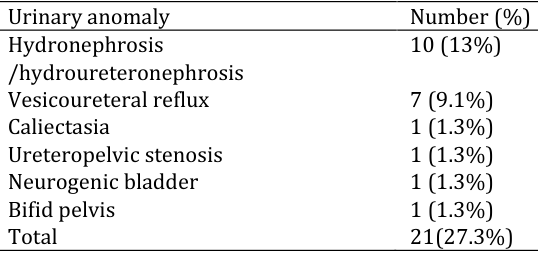
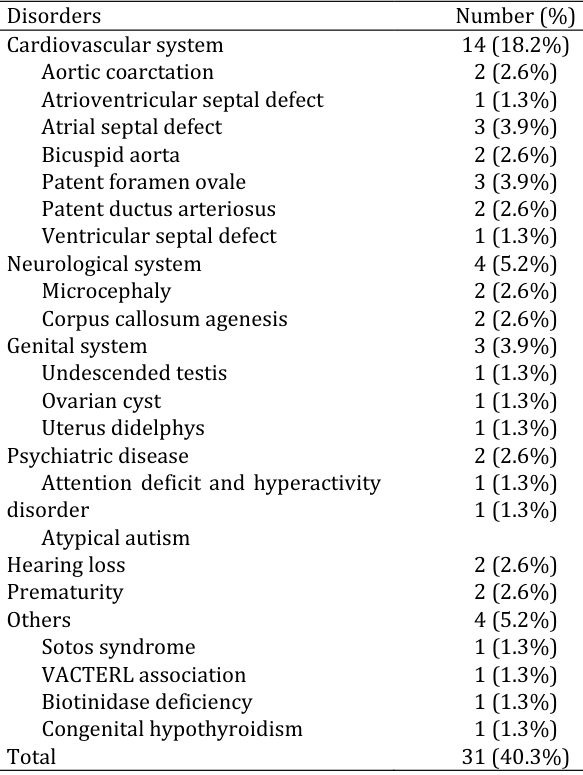
A total of 77 patients who were admitted to the pediatric nephrology outpatient clinic and diagnosed with unilateral MCDK were included in the study. The patients’ characteristics and demographic data are listed in Table 1. Urinary system anomalies, as well as extra-urinary system anomalies and diseases accompanying unilateral MCDK, are summarized in Table 2 and Table 3, respectively.
Table 1
Baseline characteristics of the study population with unilateral multicystic dysplastic kidney
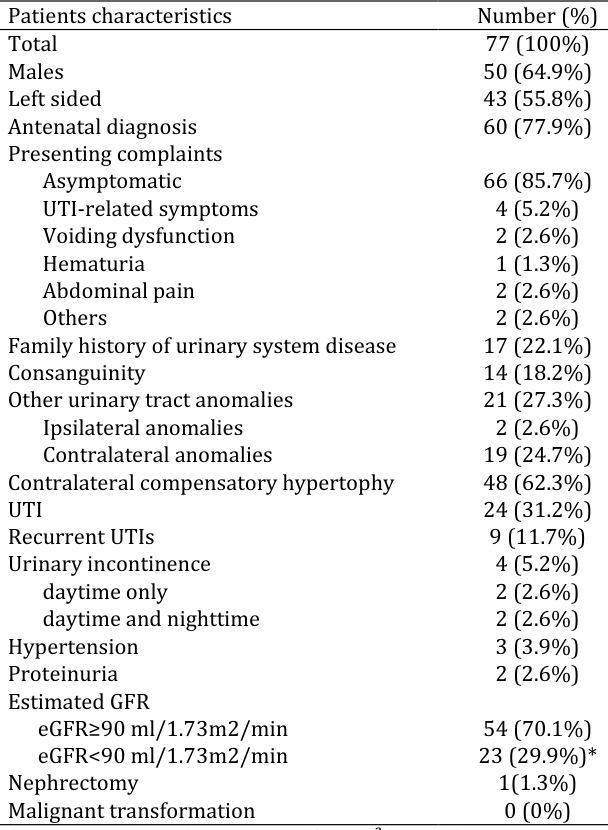
* Among patients with eGFR < 90 ml/1.73 m²/min, only one had eGFR < 60 ml/1.73 m²/min Abbrevations: UTI, urinary tract infection; eGFR, estimated glomerular filtration rate
Table 2
Urinary tract anomalies
Extra-urinary system anomalies and diseases
There was no significant difference between male and female patients in terms of age at diagnosis, follow-up duration, age at last visit, BMI, mean systolic and diastolic blood pressure and eGFR. Similarly, no differences were found between genders regarding the presence of other urinary tract anomalies, contralateral compensatory hypertrophy, urinary incontinence, hypertension, or eGFR groups. However, UTI was significantly more common in females (p=0.018), while no significant difference was observed in the frequency of recurrent UTIs (p=0.08).
Table 4
Comparison of VUR rate and eGFR at the last visit between patients with and without recurrent UTIs
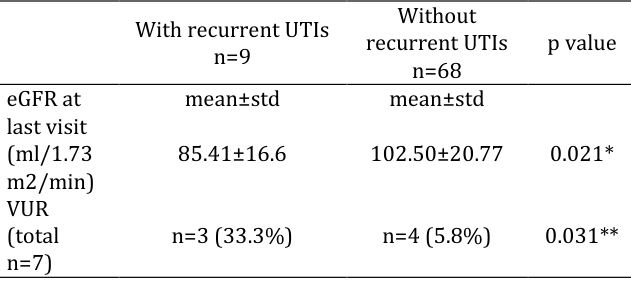
*p<0.05 (Student’s t test), **p<0.05 (Fisher’s Exact Test), Abbrevations: eGFR, estimated glomerular filtration rate; VUR, vesicoureteral reflux
When patients were grouped according to eGFR values (<90 ml/1.73 m2/min vs. ≥90 ml/1.73 m2/min), no significant differences were observed between the groups in terms of gender, age of diagnosis, age at last visit, follow-up duration, presence of contralateral compensatory hypertrophy, other urinary tract anomalies, UTI, or hypertension. However, the frequency of recurrent UTI was significantly higher in the group with eGFR <90 ml/1.73 m2/min (p=0.018). In addition, patients with recurrent UTIs showed significantly lower eGFR compared to those without recurrent UTIs (p=0.021) (Table 4).
Among the nine patients with recurrent UTIs, three had vesicoureteral reflux (VUR; grade 2-4) in contralateral kidney, one had a neurogenic bladder. The overall prevalence of VUR in the study cohort was 9.1%; however, this increased significantly to 33.3% among patients with recurrent UTIs. The rate of VUR was significantly higher in MCDK patients with recurrent UTIs compared to those without recurrent UTIs (p=0.031) (Table 4).
In total, 49 of 77 patients with MCDK underwent DMSA scintigraphy, which demonstrated contralateral renal scarring in 3 cases (6.1%). Among patients with recurrent UTIs (n=9), DMSA was performed in six, and renal scarring was identified in a single patient. In the recurrent UTI group, none of the patients with concomitant urinary tract anomalies exhibited renal scarring; therefore, only one patient in this group had a renal scar, and this patient had no other urinary tract anomalies.
There was a significant difference between the groups with and without contralateral compensatory hypertrophy in terms of follow-up duration (p=0.005) and age at last visit (p=0.012), but no difference in age at diagnosis, BMI, mean systolic and diastolic blood pressure, or eGFR (Table 5). There was also no significant difference between the same two groups regarding gender, other urinary tract anomalies, UTI, recurrent UTIs, and hypertension.
4. Discussion
MCDK is a common cystic kidney disease and has a good prognosis with conservative approach 5. In the present study, recurrent UTI was more prevalent among patients whose eGFR at the last visit was <90 mL/min/1.73 m². In addition, patients with recurrent UTIs showed significantly lower eGFR compared to those without recurrent UTIs. In the recurrent UTIs group, renal scarring was identified solely in one patient without concomitant urinary tract anomalies, while none of the patients with such urinary tract anomalies exhibited renal scarring. Our findings might suggest that recurrent UTIs may constitute a risk factor for reduced renal function in patients with MCDK, highlighting the need for close monitoring, early diagnosis, and timely treatment to prevent progression toward chronic kidney disease (CKD).
Previously published studies suggest that reported prevalence of VUR ranged from 5% to 27.7% in this patient population 4, 9, 10. It is well established that VUR is associated with recurrent UTIs and constitutes a risk factor for renal injury 11. In our study, the frequency of VUR was found to be higher in the group with recurrent UTIs compared to those without recurrent UTIs. In the study by Blachman-Braun et al.11, abnormal contralateral ultrasonographic findings in patients with MCDK was found to be associated with severe VUR. Our results may support the consideration of VUR assessment in patients with MCDK and recurrent UTIs, although further studies are needed to confirm this recommendation.
Table 5
Clinical characteristics of with and without contralateral compensatory hypertrophy
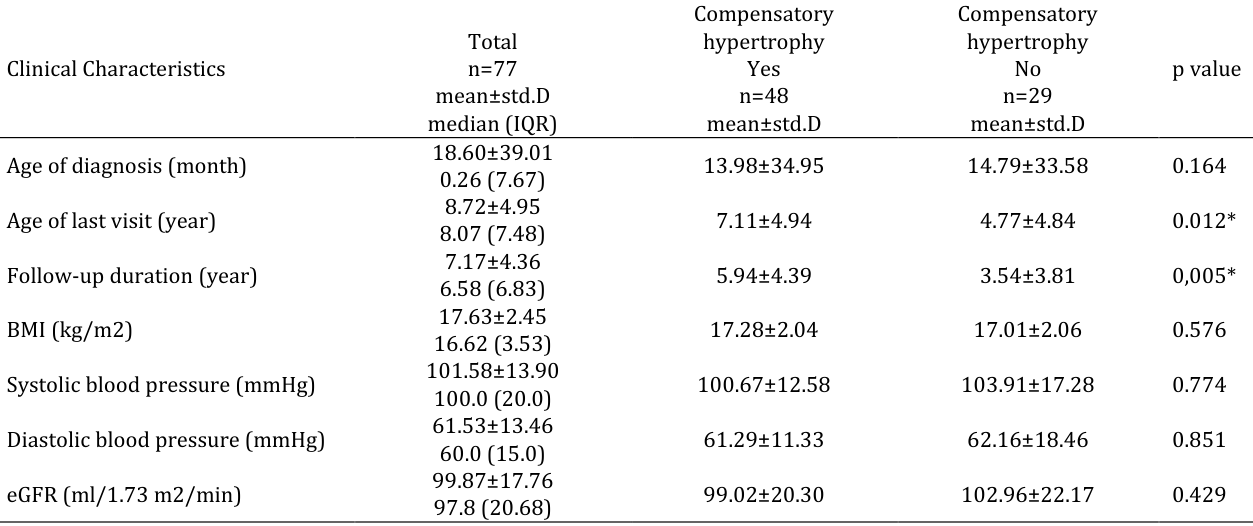
*p<0.05 (Mann-Whitney U test)
Our study indicates that the increased incidence of recurrent UTIs in patients with eGFR <90 mL/min/1.73 m² may be related to the higher prevalence of VUR within the recurrent UTIs group. However, the absence of renal scarring on DMSA scans among those with VUR in the recurrent UTIs group implies that the decline in eGFR may stem from other underlying mechanisms associated with MCDK, rather than from infection-related renal damage. Therefore, larger-scale, long-term studies are warranted to further elucidate these associations and to better understand the underlying pathophysiology.
The predominance of male patients in our cohort is consistent with most reports in the literature 5, 9. In a metanalysis of 67 studies with approximately 3500 patients found slight left-sided predominance (53%) 3, our findings similarly demonstrated a predominance of left-sided involvement. The high antenatal detection rate (77.9%) likewise reflects both the widespread implementation and the sensitivity of prenatal ultrasonography, as
3, documented in earlier studies 12. The predominance of asymptomatic cases is consistent with previous reports indicating that unilateral MCDK is usually clinically silent 13.
In our study we found that other urinary, and extraurinary system anomalies and diseases frequently accompany MCDK (27.3% and 40.3% respectively). Particularly cardiovascular system defects were found to be the most common extraurinary system anomalies in MCDK. In the study by Alamir et al 4, genitourinary system anomalies were found in 20% and extrarenal anomalies in 48%. Cardiac diseases were observed to be the most common extrarenal disease (24%). Extrarenal anomalies may play a crucial role in assessing the patient’s overall prognosis. Therefore, patients diagnosed with MCDK should be carefully examined for additional urinary tract and extraurinary system anomalies.
The reported rate of contralateral compensatory hypertrophy has been shown to vary in the literature 10, 14, 15. Such variation could be attributable to the length of follow-up. Schreuder et al.3 reported that contralateral hypertrophy was present in 77% of patients after a minimum follow-up of 10 years. In our study, contralateral compensatory hypertrophy was observed in 62.3% of cases, which is comparable to the rates reported in previous studies 4, 13.
Contralateral compensatory hypertrophy is often regarded as a favorable prognostic indicator for preserving renal function 16. Although contralateral compensatory hypertrophy is generally considered an early adaptive response, but over time it may contribute to development of hypertension and may be related with reduced kidney function 17, 18. In our cohort, contralateral compensatory hypertrophy was associated with longer follow-up duration and older age at last visit, suggesting that compensatory hypertrophy develops progressively over time. However, contralateral compensatory hypertrophy was not associated with higher eGFR values, indicating that structural hypertrophy may not always translate into functional superiority. This partially contrasts with some earlier studies reporting a positive correlation between contralateral compensatory hypertrophy and preserved renal function 16, 19 which may be explained by differences in patient age, follow-up duration, or study methodology.
Renal function outcomes in our study were generally favorable. Although 29.9% of patients had eGFR <90 ml/1.73 m²/min, only one patient had eGFR <60 ml/1.73 m²/min, supporting the notion that unilateral MCDK typically carries a good prognosis. In the study by Mashat S.D. et al.5, after a follow-up of 3.4 years, 3 of 16 patients were found to have stage 2 CKD, while the remaining patients had stage 1 CKD. Importantly, recurrent UTIs was found to be significantly more frequent in patients with lower eGFR, suggesting that infection burden may play a pivotal role in long-term renal outcomes. This is in agreement with previous reports highlighting VUR, neurogenic bladder, or obstructive anomalies as risk factors for infection and subsequent renal function decline 11.
No cases of hypertension or malignancy were detected during the follow-up of patients with MCDK by Huettinger et al. 20 and proteinuria was found in one patient (3%), and nephrectomy was carried out in four patients (13%). Our results reinforce that unilateral MCDK is largely a benign condition with generally overall prognosis, low risk of hypertension, and no evidence of malignant transformation in our cohort. However, the high frequency of associated urinary and extra-urinary anomalies highlights the necessity of comprehensive and multidisciplinary evaluation. In addition, the relationship between recurrent UTIs and reduced
eGFR emphasizes the importance of careful monitoring and prompt management of urinary infections in these patients. Patients diagnosed with MCDK should be monitored for recurrent UTIs and clinicians should be aware of risk of UTI in this group of patients. Early diagnosis and treatment of UTI in patient with MCDK is crucial for renal prognosis.
Our study had some limitations, such as retrospective design, single center setting and having a small number of patients. Follow-up durations were heterogeneous among patients, and the relatively small number of cases in some subgroups may have reduced statistical power. Another limitation of our study was the relatively small number of patients in the recurrent UTIs group. Whether the observed association between recurrent UTIs and reduced eGFR is related to concomitant urinary tract anomalies or reflects an independent impact of MCDK. Therefore, future large-scale and longitudinal studies are warranted to elucidate this relationship in patients with MCDK.
In conclusion, unilateral MCDK generally follows a favorable clinical course, but careful surveillance is required due to the high prevalence of associated anomalies and the potential impact of recurrent UTIs on renal function. Larger prospective multicenter studies are warranted to better define the prognostic value of contralateral compensatory hypertrophy and to clarify the long-term impact of associated anomalies on renal outcomes.
Statement of ethics The study received ethical approval Ankara Bilkent City Hospital (21 May 2025; approval no: TABED 1/1302/2025) and was conducted in accordance with the principles of the Declaration of Helsinki
genAI No artificial intelligence-based tools or generative AI technologies were used in this study. The entire content of the manuscript was originally prepared, reviewed, and approved by both authors.
Funding This research received no specific grant from any funding agency in the public, commercial, or not-for-profit sectors.
Conflict of interest statement The authors declare that they have no conflict of interest.
Availability of data and materials The datasets used and/or analyzed during the current study are available from the corresponding author upon reasonable request.
Author contributions All authors contributed to the study conception and design. Material preparation and data collection were performed by Mihriban İnözü, Kübra Çeleğen, Şevval İnce, Nesrin Taş, Betül Pehlivan Zorlu, Fatma Şemsa Çaycı. The analysis were performed by Mihriban İnözü, Özlem Yüksel Aksoy, Sare Gülfem Özlü, Umut Selda Bayrakçı. The first draft of the manuscript was written by Mihriban İnözü and all authors commented on previous version of the manuscript. All authors read and approved the final manuscript.
References
- Cardona-Grau D, Kogan BA. Update on Multicystic Dysplastic Kidney. Curr Urol Rep. 2015;16(10):67. Crossref
- Baker HM, Jnah AJ. Supporting Infants with Multicystic Dysplastic Kidney Disease: A Comprehensive Approach. Neonatal Netw. 2024;43(5):286-294. Crossref
- Schreuder MF, Westland R, van Wijk JA. Unilateral multicystic dysplastic kidney: a meta-analysis of observational studies on the incidence, associated urinary tract malformations and the contralateral kidney. Nephrol Dial Transplant. 2009;24(6):1810-1818. Crossref
- Alamir A, Al Rasheed SA, Al Qahtani AT, Almosa MS, Aljehani ND, Alanazi ED, et al. The Outcome of Multicystic Dysplastic Kidney Disease Patients at King Abdulaziz Medical City in Riyadh. Cureus. 2023;15(4):e37994. Crossref
- Mashat SD, El-Desoky SM, Abdulaziz Kari J. Outcome of Multi-Cystic Dysplastic Kidneys in Children. Iran J Pediatr. 2015;25(5):e2991. Crossref
- Rosenbaum DM, Korngold E, Teele RL. Sonographic assessment of renal length in normal children. AJR Am J Roentgenol. 1984;142(3):467-469. Crossref
- Kim SY, Jang MS, Kim J. Impact of Third-Generation Cephalosporin Resistance on Recurrence in Children with Febrile Urinary Tract Infections. J Pers Med. 2022;12(5):773. Crossref
- Schwartz GJ, Munoz A, Schneider MF, Mak RH, Kaskel F, Warady BA, et al. New equations to estimate GFR in children with CKD. J Am Soc Nephrol. 2009;20(3):629-637. Crossref
- Kuwertz-Broeking E, Brinkmann OA, Von Lengerke HJ, Sciuk J, Fruend S, Bulla M, et al. Unilateral multicystic dysplastic kidney: experience in children. BJU Int. 2004;93(3):388-392. Crossref
- Sharada S, Vijayakumar M, Nageswaran P, Ekambaram S, Udani A. Multicystic dysplastic kidney: a retrospective study. Indian Pediatr. 2014;51(8):641-643. Crossref
- Blachman-Braun R, Camp MM, Becerra MF, Guevara CG, Velasquez MC, Moscardi PRM, et al. Voiding Cystourethrogram in Children With Unilateral Multicystic Dysplastic Kidney: Is It Still necessary? Urology. 2020;139:156-160. Crossref
- Meyers ML, Treece AL, Brown BP, Vemulakonda VM. Imaging of fetal cystic kidney disease: multicystic dysplastic kidney versus renal cystic dysplasia. Pediatr Radiol. 2020;50(13):1921-1933. Crossref
- Akbalik Kara M, Taktak A, Alparslan C. Retrospective evaluation of the pediatric multicystic dysplastic kidney patients: experience of two centers from southeastern Turkey. Turk J Med Sci. 2021;51(3):1331-1337. Crossref
- Mansoor O, Chandar J, Rodriguez MM, Abitbol CL, Seeherunvong W, Freundlich M, et al. Long-term risk of chronic kidney disease in unilateral multicystic dysplastic kidney. Pediatr Nephrol. 2011;26(4):597-603. Crossref
- Hains DS, Bates CM, Ingraham S, Schwaderer AL. Management and etiology of the unilateral multicystic dysplastic kidney: a review. Pediatr Nephrol. 2009;24(2):233-241. Crossref
- Shin YS, Kim SW, Heo JE, Lee MJ, Park J, Han SW, et al. Abnormal parenchymal features in the contralateral kidney of patients with multicystic dysplastic kidney. Pediatr Nephrol. 2025. Crossref
- Zambaiti E, Sergio M, Baldanza F, Corrado C, Di Pace MR, Cimador M. Correlation between hypertrophy and risk of hypertension in congenital solitary functioning kidney. Pediatr Surg Int. 2019;35(1):167-174. Crossref
- Sugaya K, Ogawa Y, Hatano T, Koyama Y, Miyazato T, Naito A, et al. Compensatory renal hypertrophy and changes of renal function following nephrectomy. Hinyokika Kiyo. 2000;46(4):235-240.
- Gaither TW, Patel A, Patel C, Chuang KW, Cohen RA, Baskin LS. Natural History of Contralateral Hypertrophy in Patients with Multicystic Dysplastic Kidneys. J Urol. 2018;199(1):280-286. Crossref
- Huettinger M, Bogner G, Fischer T, Tovilo K, Fazelnia C. Clinical outcome of children with prenatally diagnosed isolated unilateral multicystic dysplastic kidney. Eur J Obstet Gynecol Reprod Biol. 2025;312:114112. Crossref
Copyright & License
This article retains the copyright and licence terms stated at its original publication. The journal's later licensing policy does not replace or amend those terms.
Read the original article PDF for the applicable copyright and reuse terms.